Why do we need public key cryptography and how it secures data
Asymmetric mathematics solves the impossible problem of sharing secrets over untrusted networks without any prior arrangement.

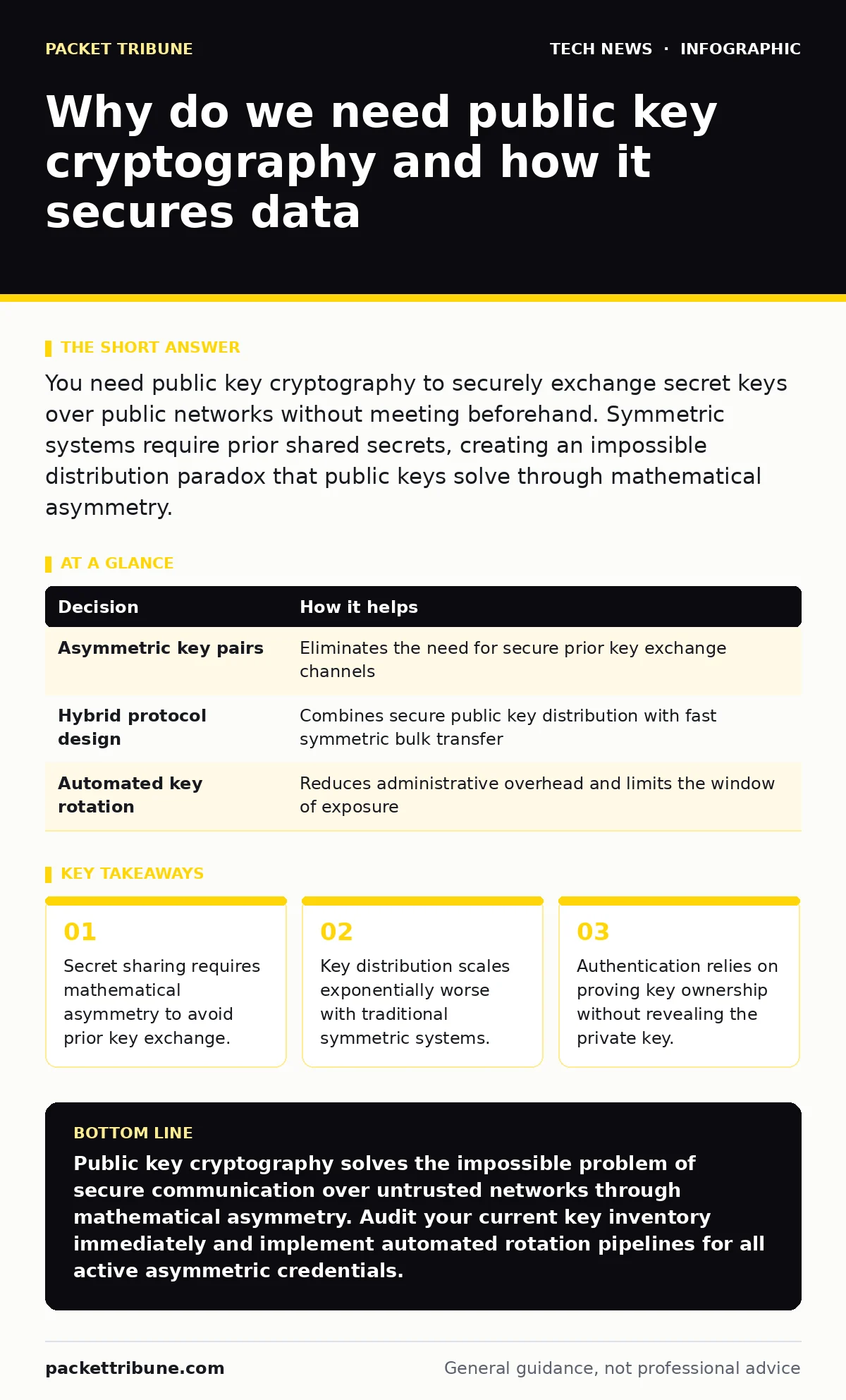
You need public key cryptography to securely exchange secret keys over public networks without meeting beforehand. Symmetric systems require prior shared secrets, creating an impossible distribution paradox that public keys solve through mathematical asymmetry.
Why do we need public key cryptography
Public key cryptography provides a mathematically secure method for two parties to establish a shared secret over an entirely hostile network without meeting beforehand. Traditional encryption relies on a single shared secret key for both locking and unlocking data, which creates an immediate logistical deadlock. Exchanging that secret securely requires a prior secure channel, rendering the system circular and impractical for global communications. Asymmetric ciphers break this deadlock by dividing responsibilities between two mathematically linked keys.
Asymmetric cryptography uses a public key to lock data and a private key to unlock it, allowing anyone to encrypt a message while only the intended recipient can read it. Mathematical trapdoor functions make this possible because they operate easily in one direction while remaining computationally infeasible to reverse without specific auxiliary information. Prime factorisation and elliptic curves serve as the primary foundations for these unidirectional operations, ensuring that interceptors cannot derive the private key from its public counterpart.
Digital signatures extend this mathematical foundation to verify identity and message integrity across open networks. Signing a hash of a document with your private key proves authorship because anyone can use your public key to verify the signature. This mechanism prevents malicious actors from tampering with data in transit or impersonating legitimate senders during a TLS handshake. Network communications would remain entirely vulnerable to eavesdropping and active tampering without these asymmetric identity proofs.
The distribution paradox of symmetric systems
Symmetric ciphers require every communicating pair of users to possess a unique, pre-shared secret key to maintain confidentiality. Scaling this requirement across large organisations causes the total number of required keys to grow quadratically with the user base. Managing thousands of distinct secrets creates severe administrative overhead and frequent operational failures when keys inevitably leak. Public key systems eliminate this quadratic explosion by assigning just one public-private key pair to each participant.
Key distribution failures historically crippled early communication networks before asymmetric algorithms removed the need for secret courier services. Modern protocols combine both approaches by using public key cryptography to securely exchange a temporary session key, which then feeds fast symmetric engines like AES encryption for bulk data transfer. This hybrid model captures the operational convenience of asymmetric setups and the raw processing speed of symmetric ciphers.
| Decision | How it helps |
|---|---|
| Asymmetric key pairs | Eliminates the need for secure prior key exchange channels |
| Hybrid protocol design | Combines secure public key distribution with fast symmetric bulk transfer |
| Automated key rotation | Reduces administrative overhead and limits the window of exposure |
Mathematical asymmetry and trapdoor functions
Trapdoor functions form the core mechanism that makes public key cryptography function reliably in adversarial environments. These specialised mathematical operations run in one direction with trivial computational effort, yet require immense processing power to reverse unless you possess a secret parameter. Modular exponentiation with large prime numbers exemplifies this principle because multiplying two massive primes is simple, but factoring their product back into originals remains intractable for classical computers.
Computational complexity protects your encrypted traffic by ensuring that breaking the cipher requires more resources than an attacker can practically marshal. Security margins depend entirely on choosing sufficiently large key sizes that outpace expected advances in computing hardware and algorithmic efficiency. Smaller keys save processing cycles but invite rapid compromise as factoring techniques improve over time.
Edge cases emerge when faulty random number generators produce predictable keys that undermine the underlying mathematical complexity. Hardware entropy sources must feed the key generation process to ensure that generated primes lack discernible patterns. Flawed entropy leaves systems vulnerable to private key reconstruction even when the cryptographic algorithms themselves remain theoretically sound.
Authentication without revealing secrets
Proving your identity across a network without transmitting your password requires the challenge-response properties inherent in public key mathematics. Servers issue random data challenges that clients must sign using their private key to demonstrate legitimate possession of the identity. Observers intercepting the challenge and the resulting signature gain no ability to impersonate the client because the private key never crosses the wire.
Zero-knowledge proofs push this concept further by allowing one party to prove they know a secret value without conveying any information about the secret itself. Authentication systems utilise these proofs to prevent credential harvesting attacks during login procedures across untrusted networks. Attackers recording authentication sessions capture only ephemeral challenge responses that hold no value for future login attempts.
Authentication protocols must strictly separate signing keys from encryption keys to prevent catastrophic cryptographic cross-protocol attacks. Blending these functions allows malicious entities to trick a user into decrypting a forged authentication challenge disguised as an ordinary ciphertext. Proper system architecture enforces distinct key pairs for distinct cryptographic duties.
Operational trade-offs in modern infrastructure
Asymmetric cryptographic operations demand significantly higher central processing unit resources than symmetric alternatives due to their reliance on complex modular arithmetic. Systems processing thousands of concurrent connections must offload cryptographic calculations to specialised hardware accelerators to prevent CPU exhaustion. Balancing security margins against processing latency remains a continuous design challenge for high-throughput network gateways.
Revocation management introduces another complex operational burden when compromised keys require immediate invalidation across distributed systems. Checking revocation status introduces network dependencies that can cause complete service outages if the validation servers become unreachable. Offline validation tokens and short certificate validity periods mitigate this dependency risk at the cost of increased administrative complexity.
Hardware security modules and Trusted Platform Modules protect private keys by isolating cryptographic operations inside tamper-resistant physical enclosures. These secure processors ensure that private keys never leave the physical boundary of the hardware chip, preventing extraction even if the host operating system suffers total compromise. Integrating hardware roots of trust is critical for maintaining long-term security in enterprise environments.
See also: Hardware security module vs tpm for your architecture · Are digital signatures legally binding? The conditions for validity
Hidden costs of key lifecycle management
Key management lifecycles incur substantial hidden expenses related to auditing, rotation, and emergency revocation procedures across large cloud environments. Organisations frequently lose track of abandoned service accounts and forgotten test keys that persist indefinitely with high-level privileges. Automated discovery tools must constantly scan infrastructure assets to identify orphaned keys before malicious actors locate them.
Regulatory compliance mandates strict logging and access controls for all cryptographic assets, creating additional overhead for engineering teams. Failing an audit due to undocumented key storage or weak algorithmic parameters results in severe financial and reputational penalties. Maintaining continuous compliance requires dedicated tooling that tracks key lineage from creation to secure decommissioning.
Interoperability issues arise when disparate software stacks implement cryptographic standards with subtle protocol variations or deprecated cipher suites. Legacy applications often reject modern public key formats, forcing administrators to maintain insecure fallback options that compromise overall perimeter security. Upgrading legacy software stacks demands careful coordination to avoid unexpected downtime in critical business workflows.
Practical deployment and system integration
Deploying public key infrastructure successfully requires methodical planning around certificate authorities, trust stores, and automated renewal pipelines. Modern deployment strategies rely on short-lived certificates that renew automatically every few weeks to minimise the risk associated with compromised credentials. Integrating these automated pipelines with OAuth identity providers ensures seamless trust establishment across microservice architectures.
Auditing your cryptographic posture involves cataloguing every active key pair, verifying algorithm strengths, and testing revocation mechanisms under simulated failure conditions. Teams must maintain comprehensive inventories of cryptographic assets to ensure rapid remediation when new vulnerabilities emerge in underlying mathematical libraries. Proactive asset discovery prevents blind spots that routinely lead to major security incidents.
Key takeaways
- Secret sharing requires mathematical asymmetry to avoid prior key exchange.
- Key distribution scales exponentially worse with traditional symmetric systems.
- Authentication relies on proving key ownership without revealing the private key.
Public key cryptography solves the impossible problem of secure communication over untrusted networks through mathematical asymmetry. Audit your current key inventory immediately and implement automated rotation pipelines for all active asymmetric credentials.
Frequently asked questions
Can quantum computers break public key cryptography?
Large-scale quantum computers running specialised algorithms can theoretically factor large prime numbers and solve discrete logarithms efficiently. This capability threatens widely used asymmetric algorithms, prompting ongoing standardisation efforts for post-quantum cryptographic replacements.
How do you choose the right key size for asymmetric ciphers?
Choosing the correct key size requires balancing required security lifespan against available processing overhead and hardware performance constraints. Organisations typically follow public standards guidance to select key lengths that provide adequate protection well into the future.
What happens if a private key is accidentally published?
Publishing a private key immediately destroys the confidentiality and authenticity guarantees of the associated public key. You must revoke the compromised key instantly, generate a fresh key pair, and audit dependent systems for unauthorised access.
Why are hybrid encryption systems used instead of purely asymmetric ones?
Purely asymmetric encryption demands immense processing power, making it too slow for bulk data transfer across modern networks. Hybrid systems solve this by using public keys to securely exchange a fast symmetric session key for the bulk data payload.
How this guide was produced: written by the Packet Tribune editorial team with AI assistance, checked against the public references listed below, and reviewed when the facts change. See our editorial policy or report an error.