Should i use post quantum encryption to secure data today
Post-quantum cryptographic algorithms demand significantly larger public keys and ciphertexts, straining existing network bandwidth.

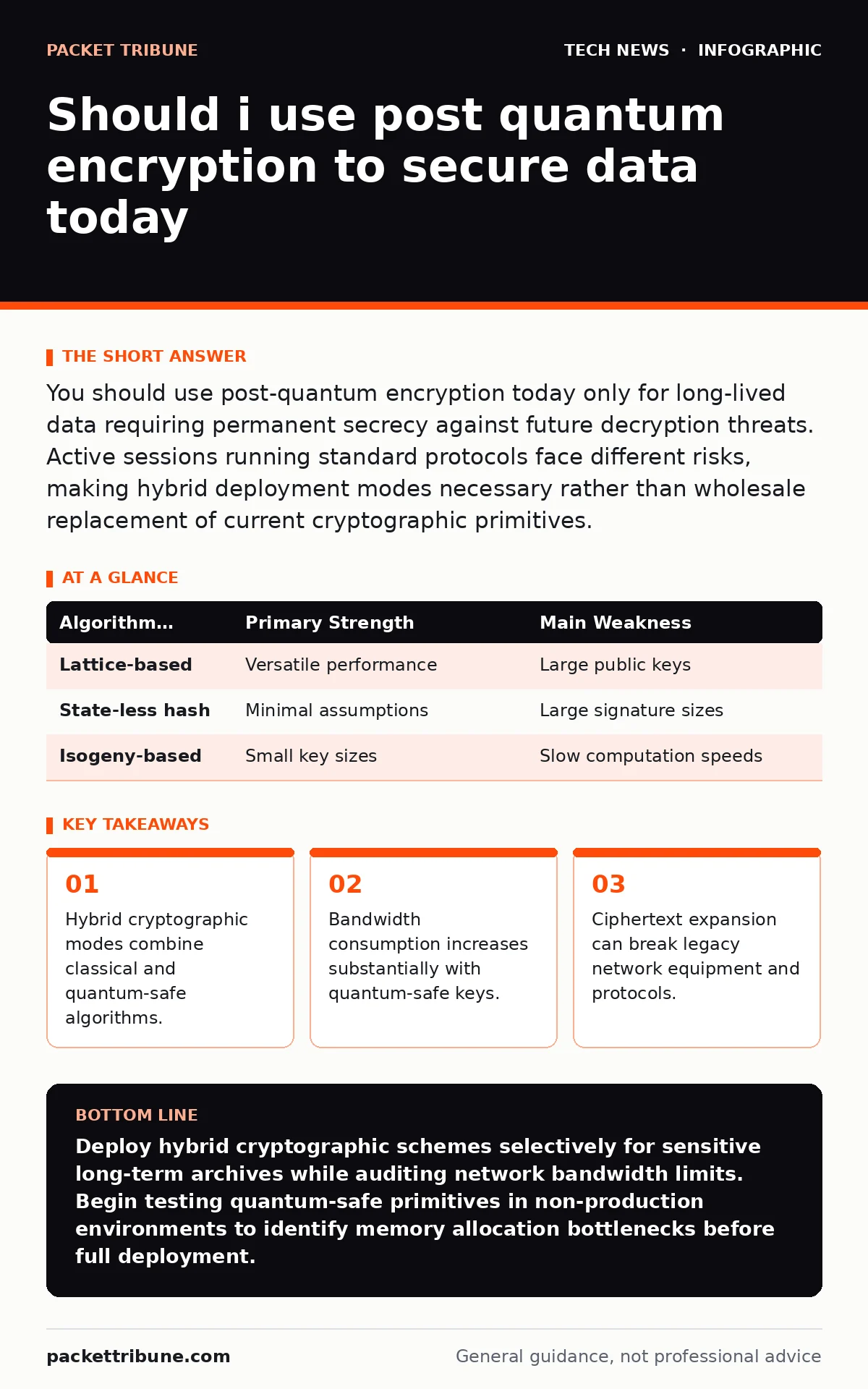
You should use post-quantum encryption today only for long-lived data requiring permanent secrecy against future decryption threats. Active sessions running standard protocols face different risks, making hybrid deployment modes necessary rather than wholesale replacement of current cryptographic primitives.
Should i use post quantum encryption right now?
You should use post-quantum encryption right now primarily for sensitive data archives that adversaries might intercept and store for future decryption. Data captured today remains vulnerable to retrospective decryption once stable quantum hardware becomes widely available.
Organizations face a genuine dilemma regarding long-term confidentiality versus immediate performance costs. Assessing your risk profile requires identifying assets that need multi-decade secrecy rather than upgrading every single network connection indiscriminately.
What is post-quantum cryptography?
Post-quantum cryptography consists of mathematical algorithms designed to resist attacks from large-scale quantum computers capable of breaking classical algorithms like RSA encryption. These mathematical problems rely on lattices, hash functions, and multivariate equations rather than prime factorization.
Mathematical foundations shift away from number theory toward geometric structures in multidimensional space. Understanding these new foundations helps system administrators evaluate the computational overhead introduced by larger mathematical structures.
| Algorithm Family | Primary Strength | Main Weakness |
|---|---|---|
| Lattice-based | Versatile performance | Large public keys |
| State-less hash | Minimal assumptions | Large signature sizes |
| Isogeny-based | Small key sizes | Slow computation speeds |
How do hybrid cryptographic schemes work?
Hybrid cryptographic schemes combine traditional algorithms with post-quantum primitives inside protocols like TLS certificates to maintain security even if one algorithm fails. Combining 2 distinct mathematical approaches ensures that an attacker must break both systems to compromise a single session.
Failing to implement proper combining functions can inadvertently introduce vulnerabilities rather than closing security gaps. Careful engineering guarantees that the failure of the newer post-quantum component does not weaken the proven classical cipher protecting the session.
Why does ciphertext expansion matter for network performance?
Ciphertext expansion matters for network performance because quantum-safe algorithms generate data packets too large for standard buffers inside load balancers. Network interfaces and intermediate routing devices often drop packets exceeding traditional MTU limits when dealing with oversized cryptographic payloads.
Engineers must reconfigure packet fragmentation handling across the entire network topology. Ignoring packet size inflation leads to severe latency spikes and connection timeouts during high-traffic operational peaks.
When should you prioritize migrating digital signatures over encryption?
You should prioritize migrating digital signatures over encryption when verifying software authenticity and update mechanisms matters more than hiding routine message contents. Compromised signatures allow malicious actors to inject arbitrary code into trusted operational pipelines.
Digital signatures face immediate threats because an attacker can forge updates if signing keys fall to quantum attacks. Securing the software supply chain requires substituting classical signature schemes before tackling bulk data encryption.
See also: Encryption at Rest: The Hidden Costs and Real Protection Limits
Where do memory constraints affect implementation?
Memory constraints affect implementation severely because embedded systems and microcontrollers lack the RAM required to process multi-kilobyte public keys safely. Stack overflows occur frequently when systems attempt to allocate large quantum-safe structures in restricted memory environments.
Hardware accelerators designed for older algorithms cannot process lattice matrices without significant firmware modifications. Developers must audit hardware capabilities across all edge devices before rolling out new cryptographic suites.
Which failure modes threaten early adoption?
Early adoption faces unexpected failure modes involving side-channel vulnerabilities and improper random number generation during initial key exchange phases. Microcontroller implementations leak timing information during lattice operations more easily than classical counterparts.
Adversaries exploit power consumption patterns to extract secret keys from poorly isolated hardware modules. Protecting against these physical attacks requires constant-time programming techniques that negate observable execution variances.
How does protocol negotiation handle algorithmic transitions?
Protocol negotiation handles algorithmic transitions by exchanging capability lists where clients and servers agree on supported quantum-safe primitives before data transfer begins. Negotiating multiple cipher suites simultaneously prevents connection failures when communicating with unupgraded legacy endpoints.
Fallback mechanisms ensure compatibility during extended migration windows spanning several years. Complexity increases significantly when debugging negotiation failures across heterogeneous enterprise environments running mixed software versions.
Key takeaways
- Hybrid cryptographic modes combine classical and quantum-safe algorithms.
- Bandwidth consumption increases substantially with quantum-safe keys.
- Ciphertext expansion can break legacy network equipment and protocols.
Deploy hybrid cryptographic schemes selectively for sensitive long-term archives while auditing network bandwidth limits. Begin testing quantum-safe primitives in non-production environments to identify memory allocation bottlenecks before full deployment.
Frequently asked questions
Can quantum computers break symmetric encryption like AES?
Symmetric encryption resists quantum attacks more effectively by requiring key length doubling rather than complete algorithm replacement.
Are all post-quantum algorithms equally secure against side-channel attacks?
Different mathematical families exhibit vastly unique side-channel characteristics requiring specialized countermeasures for physical implementations.
How long will the migration to post-quantum standards take for large enterprises?
Complete enterprise migration requires several years due to complex software dependencies and hardware refresh cycles.
Do quantum-safe algorithms require new hardware infrastructure?
Many post-quantum algorithms run on existing processors, though memory requirements often necessitate firmware or hardware updates for constrained devices.
How this guide was produced: written by the Packet Tribune editorial team with AI assistance, checked against the public references listed below, and reviewed when the facts change. See our editorial policy or report an error.