AI video object removal and the limits of automated editing
Automated video object removal leaves subtle spatial artifacts that standard forensic inspection can identify reliably across frames.

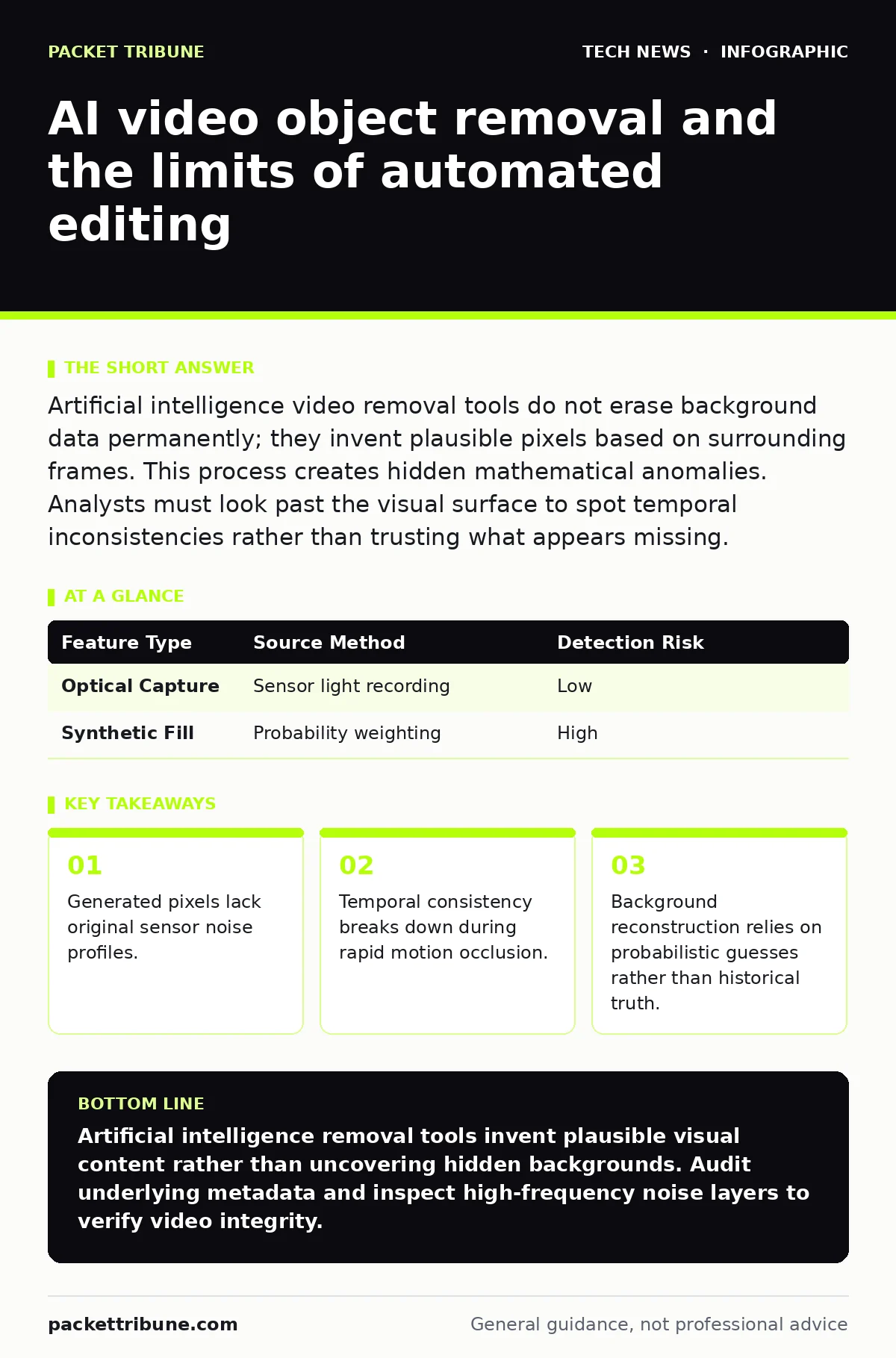
Artificial intelligence video removal tools do not erase background data permanently; they invent plausible pixels based on surrounding frames. This process creates hidden mathematical anomalies. Analysts must look past the visual surface to spot temporal inconsistencies rather than trusting what appears missing.
Misreading: Erased objects leave blank spaces
Correct reading: Generative models fill vacant areas by synthesising new pixels from neighboring spatial data. Synthetic fill operations generate textures that mimic the surrounding environment without recovering actual background information. Background reconstruction relies on mathematical interpolation rather than uncovering hidden visual layers beneath the target.
Pixel interpolation algorithms evaluate surrounding color gradients to paint over missing sections. Mathematical weight distributions determine the most probable visual patterns for the newly created surface.
Unseen edges often reveal abrupt shifts in lighting direction or shadow alignment. Visual continuity breaks down when the algorithm fails to calculate proper occlusion angles for complex three-dimensional lighting environments.
Misreading: Removal guarantees complete privacy
Correct reading: Digital deletion of a face or license plate alters visual presentation while leaving underlying metadata intact. Metadata streams often retain timestamps, coordinate markers, and camera identifiers associated with the original recording session. Effective IT asset management practices require tracking these residual data files alongside the modified video output.
Imagine an operator erasing a confidential badge from a workplace recording to share publicly. Original container files frequently store audit trails, editing software signatures, and proprietary format tags.
Secure software development pipelines handling media processing must account for these hidden data retention vectors during export routines. Complete data sanitization demands stripping container metadata rather than merely altering the visible stream.
Misreading: AI reconstruction uses hidden source footage
Correct reading: Neural networks synthesize missing picture elements through probability weights rather than retrieving blocked background angles. Computational generation invents plausible visual details that fit statistical patterns learned during training phases.
| Feature Type | Source Method | Detection Risk |
|---|---|---|
| Optical Capture | Sensor light recording | Low |
| Synthetic Fill | Probability weighting | High |
Edge bleeding occurs when generated pixel clusters blend poorly with genuine optical data surrounding the edited boundary. Automated blending filters smooth these transition zones, but they frequently introduce unnatural softness or repetitive pattern tiling.
Suppose a system replaces a moving vehicle with standard asphalt textures. The resulting pavement lacks genuine tire wear marks, oil stains, and weathering consistency found across the rest of the street.
Misreading: Static scenes prevent editing detection
Correct reading: Unmoving camera shots still betray digital tampering through subtle shifts in lighting consistency and grain structure. Generated replacement regions lack the physical sensor noise inherent to the original optical capture device. Analysts spot these discrepancies by measuring high-frequency luminance variations across stationary background elements.
Static environments simplify tracking tasks for software, but they eliminate natural micro-movements found in live camera sensors. Ambient light flicker, thermal sensor noise, and atmospheric distortion create constant minute changes across real video frames.
Virtualization security frameworks testing media processing pipelines must evaluate how compute throttling impacts temporal stability during heavy rendering tasks. Artificial fills often appear unnaturally static compared to the breathing quality of genuine optical recordings.
Misreading: Frame rates mask manipulation artifacts
Correct reading: High frame rates fail to hide temporal jitter when object removal algorithms miscalculate motion vectors between successive images. Rapid movement causes edge blurring and pixel swimming as the software struggles to maintain spatial continuity.
Fast motion forces predictive models to guess intermediate states without sufficient visual reference points. These calculation errors manifest as shimmering halos or ghosting traces around the perimeter of the edited zone.
Email security systems intercepting manipulated video files should flag files exhibiting anomalous compression patterns or unusual bit-rate fluctuations near moving subjects. Frame interpolation anomalies create distinct compression signatures that automated inspection tools can isolate.
See also: Should I enable firmware TPM and what breaks when you do · Should i use post quantum encryption to secure data today
Misreading: Audio tracks remain unaffected by visual edits
Correct reading: Removing large objects often requires altering environmental audio tracks to match the newly sanitized visual space. Silence or artificial room tone added to cover the edit creates acoustic mismatches with surrounding audio channels.
Visual modifications frequently demand companion audio adjustments to prevent viewer disorientation during playback. Acoustic analysis tools can detect phase cancellation or frequency clipping introduced when engineers patch over original background sounds.
Imagine an edited clip where a passing truck vanishes silently from a busy street scene. The sudden absence of low-frequency rumble reveals an unnatural acoustic vacuum that contradicts the bustling visual environment.
Key takeaways
- Generated pixels lack original sensor noise profiles.
- Temporal consistency breaks down during rapid motion occlusion.
- Background reconstruction relies on probabilistic guesses rather than historical truth.
Artificial intelligence removal tools invent plausible visual content rather than uncovering hidden backgrounds. Audit underlying metadata and inspect high-frequency noise layers to verify video integrity.
Frequently asked questions
Can forensic software prove an object was removed from a video file?
Forensic tools identify object removal by detecting statistical inconsistencies in noise patterns, lighting angles, and temporal frame continuity.
Do neural network fill operations leave permanent mathematical signatures?
Neural networks generate repeating textural patterns and lack genuine optical sensor noise, leaving detectable mathematical fingerprints across modified regions.
Why do fast-moving objects create more editing artifacts?
Rapid movement reduces the temporal reference data available for predictive algorithms, forcing models to interpolate missing pixels across wide motion gaps.
Are metadata streams altered automatically when objects are deleted?
Editing software typically preserves original file container metadata, leaving timestamps, camera parameters, and audit trails intact unless explicitly scrubbed.
How this guide was produced: written by the Packet Tribune editorial team with AI assistance, checked against the public references listed below, and reviewed when the facts change. See our editorial policy or report an error.