How PHP Application Vulnerabilities Work: A Step-by-Step Breakdown
PHP flaws often bypass standard perimeter defences because the server executes untrusted input as code before security controls can inspect the output.

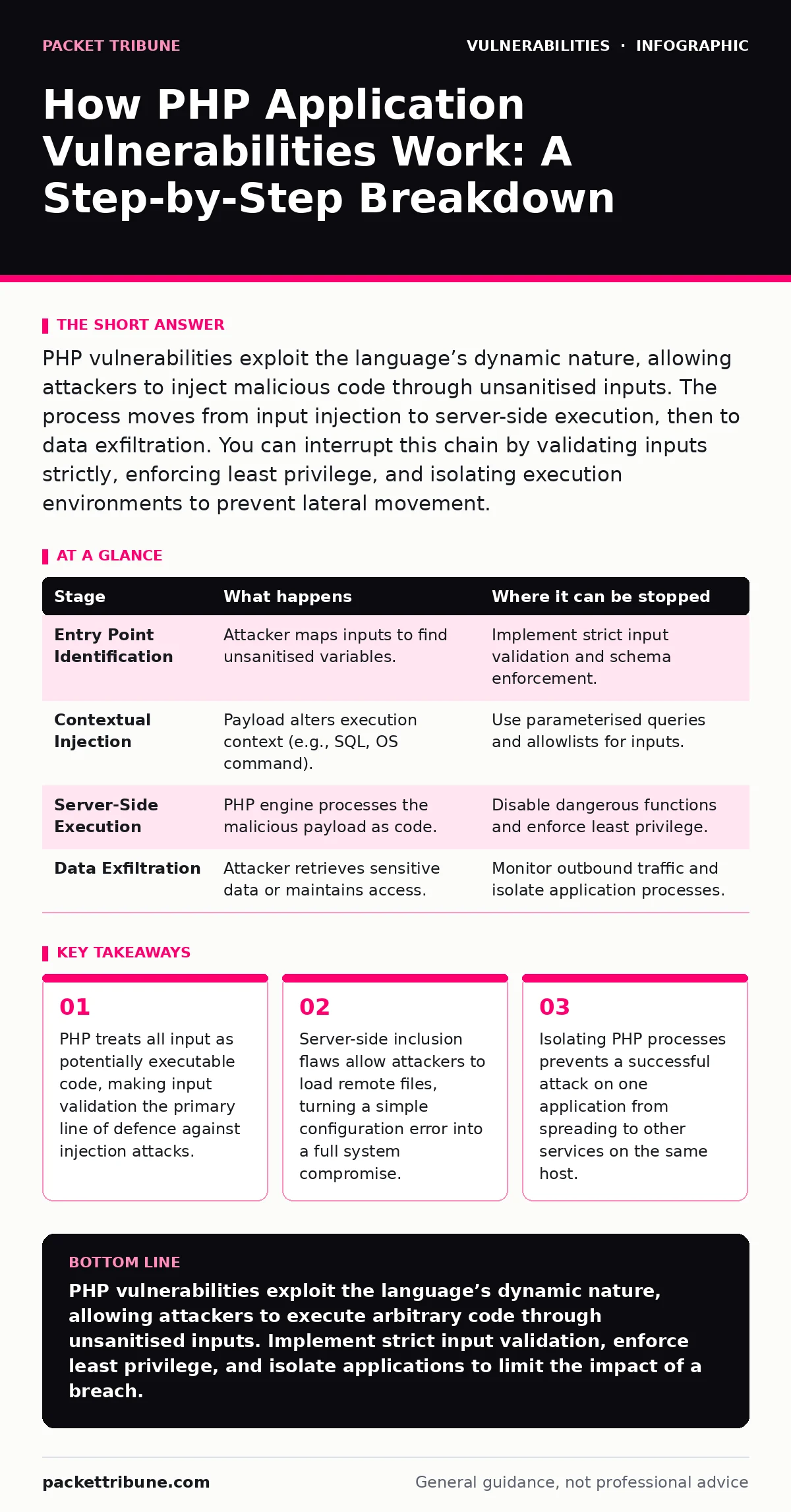
PHP vulnerabilities exploit the language’s dynamic nature, allowing attackers to inject malicious code through unsanitised inputs. The process moves from input injection to server-side execution, then to data exfiltration. You can interrupt this chain by validating inputs strictly, enforcing least privilege, and isolating execution environments to prevent lateral movement.
The Input Vector
Stage 1: Entry Point Identification
The attacker begins by mapping the application’s surface area. PHP applications often expose multiple entry points, including query parameters, POST bodies, HTTP headers, and cookies. The attacker looks for inputs that the application accepts without strict type checking. Unlike compiled languages, PHP is loosely typed, meaning a string can often be interpreted as an integer or an array depending on context. This flexibility creates ambiguity in how the application processes user data.
The attacker relies on the developer’s assumption that certain fields will only contain specific data types. Suppose a search field expects text but accepts a specially crafted string that mimics a file path. The application may process this string as a directive rather than plain text. This stage is purely reconnaissance. The attacker sends benign requests to see how the application responds to different input formats. They note which inputs are reflected in the output and which are stored. This mapping reveals where the application logic is most permissive.
The Execution Gap
Stage 2: Contextual Injection
Once an entry point is identified, the attacker crafts a payload designed to change the context of the execution. In PHP, the boundary between data and code is often thin. If the application concatenates user input into a SQL query, a file path, or a system command, the attacker inserts syntax that terminates the original command and starts a new one. This is the core mechanism of injection vulnerabilities. The flaw relies on the application trusting the input to remain within its expected semantic scope.
For example, if a user ID is embedded in a database query without parameterisation, the attacker can add a single quote and a logical operator to bypass authentication. The attack succeeds because the server executes the modified instruction. This stage exploits the lack of separation between data handling and code execution. The attacker does not need to break into the server; they simply trick the server into doing their work for them.
| Stage | What happens | Where it can be stopped |
|---|---|---|
| Entry Point Identification | Attacker maps inputs to find unsanitised variables. | Implement strict input validation and schema enforcement. |
| Contextual Injection | Payload alters execution context (e.g., SQL, OS command). | Use parameterised queries and allowlists for inputs. |
| Server-Side Execution | PHP engine processes the malicious payload as code. | Disable dangerous functions and enforce least privilege. |
| Data Exfiltration | Attacker retrieves sensitive data or maintains access. | Monitor outbound traffic and isolate application processes. |
The Server-Side Flaw
Stage 3: Dynamic Execution
PHP’s dynamic features, such as variable variables and dynamic function calls, are frequent sources of vulnerability. If an application uses a user-controlled value to determine which function to execute or which variable to access, an attacker can force the execution of unintended code. This is often seen in remote file inclusion flaws, where a parameter specifies a configuration file. If the attacker can point this parameter to a URL they control, the server downloads and executes that remote code.
The flaw relies on the server’s ability to fetch and execute external resources. This stage is particularly dangerous because it does not require a bug in the application logic itself, but rather a permissive configuration. The attacker exploits the trust the server places in the inclusion mechanism. Even if the application code is secure, the underlying PHP settings may allow dangerous behaviour. Disabling remote file inclusion and restricting the include path are standard mitigations, but many deployments leave these defaults unchanged.
Privilege Escalation
Stage 4: Lateral Movement
After initial execution, the attacker seeks to expand their access. PHP applications often run with elevated privileges or share resources with other services. If the initial compromise provides only read access to a directory, the attacker looks for writable files or misconfigured permissions that allow them to write a persistent script. This stage relies on the principle of least privilege not being enforced. The attacker may exploit business logic flaws to access features they are not authorised to use.
For instance, if an API endpoint allows a user to update their profile, the attacker might change the ID parameter to update another user’s account. This is not a traditional injection but a failure in access control. The application assumes that because the user is authenticated, they have the right to perform all associated actions. The attacker interrupts the expected flow by manipulating identifiers. This stage is often overlooked because it does not involve breaking encryption or exploiting a buffer overflow. Instead, it exploits the application’s misunderstanding of its own security model.
Persistence and Exfiltration
Stage 5: Maintaining Access
Once the attacker has established a foothold, they aim to maintain access even if the initial vulnerability is patched. They may write a web shell to a writable directory or modify legitimate application files to include their malicious code. This persistence mechanism ensures that they can return to the system at any time. The attacker relies on the lack of integrity monitoring. If the application does not verify that its files have not been altered, the attacker can hide their code within existing scripts.
They may also establish a reverse shell, connecting back to their own server to bypass outbound firewalls. This stage exploits the trust the system places in its own file integrity. The attacker does not need to keep the initial injection point open; they only need the server to execute their persistent code. This makes detection difficult because the malicious activity looks like normal application processing. The key to stopping this is to monitor for unexpected file changes and restrict write permissions to only those processes that truly need them.
See also: Dependency Scanning Implementation: From Policy to Pipeline
The Detection Gap
Stage 6: Evasion and Monitoring
Attackers often use techniques to evade detection by security tools. They may encode their payloads to bypass signature-based filters or use slow, distributed requests to avoid triggering rate limits. This stage relies on the assumption that security monitoring is static and rule-based. If the monitoring system only looks for known malicious patterns, the attacker can modify their payload slightly to avoid detection. This is why dependency scanning alone is insufficient; it identifies known vulnerabilities in libraries but does not detect how those libraries are being misused in real-time.
The attacker exploits the gap between static analysis and dynamic behaviour. They may also use legitimate tools, such as debugging libraries, to interact with the system. This makes their activity blend in with normal development operations. The defence against this is behavioural analysis, which looks for anomalies in request patterns rather than specific signatures. However, this requires a baseline of normal activity, which can be difficult to establish in dynamic applications.
Mitigation Strategies
Stage 7: Defensive Depth
Defending against PHP vulnerabilities requires multiple layers of protection. Input validation is the first line, ensuring that all data conforms to expected formats. However, validation alone is not enough. Output encoding prevents stored data from being interpreted as code when displayed to users. Proper error handling ensures that sensitive information is not leaked to attackers during debugging. Regular updates and emergency patching processes ensure that known vulnerabilities in the PHP engine and its extensions are addressed promptly.
Additionally, isolating applications using containers or virtual machines limits the impact of a successful compromise. This architectural approach ensures that even if an attacker gains access to one application, they cannot easily move to others. The key is to assume that breaches will occur and to design systems that limit the damage. This mindset shifts the focus from prevention to containment and recovery.
The Human Factor
Stage 8: Developer Awareness
The most effective defence is secure coding practices. Developers must understand how PHP handles data and execution. They should use modern frameworks that provide built-in protection against common vulnerabilities. Code reviews should focus on security, not just functionality. Training should cover the specific risks associated with dynamic languages, such as type juggling and dynamic execution.
Awareness of HTTP security headers can also help mitigate certain types of attacks, such as cross-site scripting, by instructing browsers on how to handle content. However, headers are a defence-in-depth measure, not a replacement for secure code. The goal is to create a culture where security is considered at every stage of development. This includes threat modelling, secure design, and rigorous testing. By integrating security into the development lifecycle, organisations can reduce the number of vulnerabilities that reach production.
Key takeaways
- PHP treats all input as potentially executable code, making input validation the primary line of defence against injection attacks.
- Server-side inclusion flaws allow attackers to load remote files, turning a simple configuration error into a full system compromise.
- Isolating PHP processes prevents a successful attack on one application from spreading to other services on the same host.
PHP vulnerabilities exploit the language’s dynamic nature, allowing attackers to execute arbitrary code through unsanitised inputs. Implement strict input validation, enforce least privilege, and isolate applications to limit the impact of a breach.
Frequently asked questions
Why are PHP applications more vulnerable to injection attacks?
PHP’s loose typing and dynamic execution features make it easier for attackers to alter the context of user input, turning data into executable code if not properly sanitised.
How can I prevent remote file inclusion attacks?
Disable remote file inclusion in your PHP configuration and restrict the include path to only trusted local directories, ensuring the server cannot execute external code.
What is the role of parameterised queries in preventing SQL injection?
Parameterised queries separate code from data, ensuring that user input is always treated as data and never as executable SQL commands, regardless of its content.
Can a web application firewall stop all PHP attacks?
No, web application firewalls can block known attack patterns but can be bypassed by sophisticated attackers; they should be used as part of a broader defence-in-depth strategy.
How this guide was produced: written by the Packet Tribune editorial team with AI assistance, checked against the public references listed below, and reviewed when the facts change. See our editorial policy or report an error.