How To Read VEX Documents Without Misinterpreting Risk
A VEX document explains why a vulnerability is not exploitable in your specific context, rather than claiming the flaw has been fixed in the code.

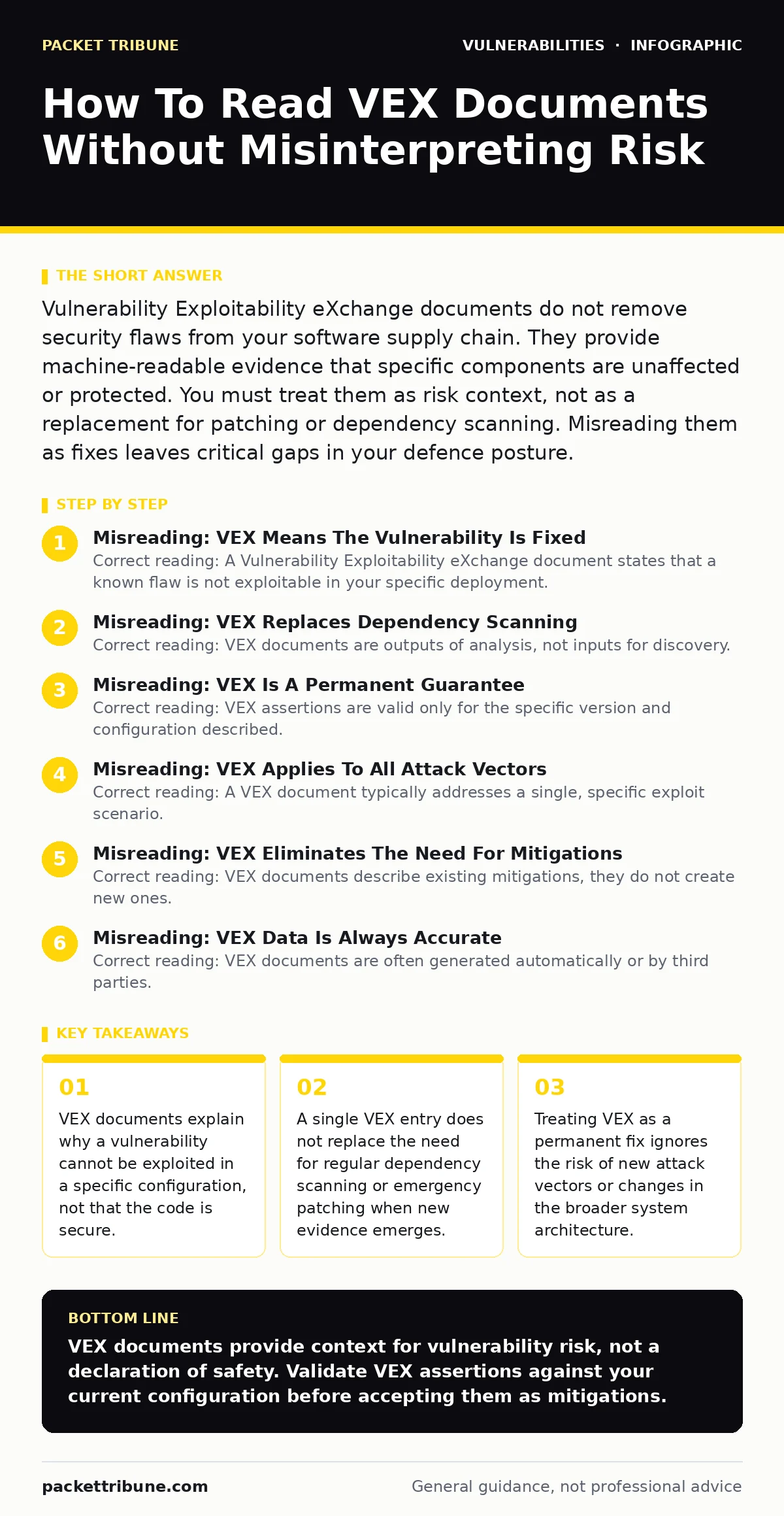
Vulnerability Exploitability eXchange documents do not remove security flaws from your software supply chain. They provide machine-readable evidence that specific components are unaffected or protected. You must treat them as risk context, not as a replacement for patching or dependency scanning. Misreading them as fixes leaves critical gaps in your defence posture.
Misreading: VEX Means The Vulnerability Is Fixed
Correct reading: A Vulnerability Exploitability eXchange document states that a known flaw is not exploitable in your specific deployment. It does not claim the underlying code defect has been corrected. The vulnerability remains in the binary or library. The document merely asserts that your current environment prevents an attacker from reaching or executing the malicious code path. You must still track the upstream fix.
Imagine a web server running a library with a buffer overflow. The VEX document might state that the server’s memory allocator prevents the overflow from causing code execution. The flaw is still there. If you upgrade the memory allocator or change the server configuration, the protection might vanish. The VEX document is tied to a specific version and configuration. It is not a universal cure.
Misreading: VEX Replaces Dependency Scanning
Correct reading: VEX documents are outputs of analysis, not inputs for discovery. You cannot rely on VEX files to find which libraries you use. Dependency scanning tools identify the components present in your environment. VEX documents then filter those results to show which identified vulnerabilities are actionable. Skipping the scanning step leaves you blind to components that lack VEX documentation entirely. Many open-source libraries do not publish VEX data.
Without a complete inventory of your dependencies, you cannot match VEX entries to your assets. A missing VEX document for a component usually means the risk is unknown or unassessed, not that the component is safe. You must combine automated scanning with manual review of VEX data. This ensures you see both known safe components and those requiring immediate attention. Relying solely on VEX creates a false sense of security in your supply chain.
Misreading: VEX Is A Permanent Guarantee
Correct reading: VEX assertions are valid only for the specific version and configuration described. Changes to the operating system, network topology, or adjacent services can invalidate a previous VEX statement. An assertion that a port is closed today might be false tomorrow if a new service opens that port. VEX documents are snapshots in time. They require periodic re-evaluation. Treating them as permanent reduces your ability to respond to evolving threats.
Suppose a VEX document claims a database vulnerability is mitigated because the database runs in a container with no network access. If you later enable network access for backup purposes, the mitigation fails. The VEX document does not automatically update. You must monitor for configuration drift. Regular reviews ensure that the context described in the VEX document still matches your live environment. This prevents stale data from masking real risks.
Misreading: VEX Applies To All Attack Vectors
Correct reading: A VEX document typically addresses a single, specific exploit scenario. It does not guarantee protection against all possible attack paths. A vulnerability might be mitigated against remote code execution but still allow denial of service. Or it might be safe against external attackers but exploitable by an insider with local access. VEX documents often focus on the most likely or severe vector. You must consider alternative paths.
For example, a VEX entry might state that a PHP application vulnerability is not exploitable because the input is sanitised by a web application firewall. This protects against remote injection attacks. It does not protect against local file inclusion if an attacker gains shell access. You must map the VEX assertion to your specific threat model. Ignoring secondary vectors leaves hidden weaknesses in your defence. This is particularly relevant when analysing complex API vulnerabilities where multiple entry points exist.
Misreading: VEX Eliminates The Need For Mitigations
Correct reading: VEX documents describe existing mitigations, they do not create new ones. If a VEX document cites a firewall rule as the reason a vulnerability is not exploitable, you must maintain that firewall rule. If the rule is removed, the vulnerability becomes exploitable. VEX is evidence of safety, not the safety mechanism itself. You must continue to enforce the compensating controls referenced in the document.
Imagine a VEX document states that a WordPress plugin update policy prevents a known exploit because the plugin is not installed. If you later install the plugin for a new feature, the VEX assertion is void. You must track the lifecycle of the components mentioned in VEX. This includes monitoring for changes in your deployment pipeline. VEX documents help you prioritise patches, but they do not replace the need for active defence measures.
See also: EPSS Score Mechanics: How Probability Drives Patch Prioritisation · Cross-Site Request Forgery Prevention Checklist for Secure Web Apps
Misreading: VEX Data Is Always Accurate
Correct reading: VEX documents are often generated automatically or by third parties. They may contain errors, outdated information, or incorrect assumptions about your environment. The quality of VEX data varies significantly across vendors and projects. You must validate critical VEX assertions against your own testing. Blind trust in automated VEX generation can lead to missed vulnerabilities. Human review is necessary for high-risk components.
A vendor might publish a VEX document claiming a vulnerability is not present because a feature is disabled by default. If your deployment enables that feature, the assertion is false for you. You must verify the configuration assumptions. This is especially true for complex systems where default settings vary. Cross-referencing VEX data with your own security assessments ensures accuracy. Do not assume that the presence of a VEX document guarantees correctness.
Misreading: VEX Is Only For Large Enterprises
Correct reading: VEX documents are useful for any organisation that manages software dependencies. Small teams can benefit from reduced noise in vulnerability reports. VEX helps prioritise remediation efforts by filtering out false positives. You do not need a large security team to use VEX. Basic understanding of your software stack is sufficient. Ignoring VEX because of organisational size means missing out on efficient risk management.
Even small applications use third-party libraries. These libraries often have known vulnerabilities. VEX documents can tell you which ones are relevant to your build. This saves time and resources. You can focus on fixing real risks rather than chasing every CVE. This approach is compatible with emergency patching strategies, allowing you to triage effectively. VEX is a tool for clarity, not just scale.
Key takeaways
- VEX documents explain why a vulnerability cannot be exploited in a specific configuration, not that the code is secure.
- A single VEX entry does not replace the need for regular dependency scanning or emergency patching when new evidence emerges.
- Treating VEX as a permanent fix ignores the risk of new attack vectors or changes in the broader system architecture.
VEX documents provide context for vulnerability risk, not a declaration of safety. Validate VEX assertions against your current configuration before accepting them as mitigations.
Frequently asked questions
Can I automatically apply VEX documents to my vulnerability scanner?
Most modern scanners support VEX import. You must ensure the scanner matches VEX entries to your specific software versions. Incorrect matching leads to false negatives.
Who is responsible for creating VEX documents?
VEX documents are typically created by software vendors or distributors. You can also create internal VEX documents for your own custom configurations and mitigations.
Does a VEX document mean I do not need to patch?
No. VEX explains why a patch is not immediately urgent for your specific setup. You should still plan to patch when possible to reduce long-term risk and complexity.
How do I verify a VEX document is correct?
Review the stated mitigations and ensure they exist in your environment. Test the specific exploit scenario if possible. Cross-reference with other sources of vulnerability intelligence.
How this guide was produced: written by the Packet Tribune editorial team with AI assistance, checked against the public references listed below, and reviewed when the facts change. See our editorial policy or report an error.