CVSS Environmental Scores: Why Base Scores Mislead Risk Teams
Environmental scoring adjusts abstract vulnerability severity to your specific infrastructure, revealing true exposure where base scores remain static and misleading.

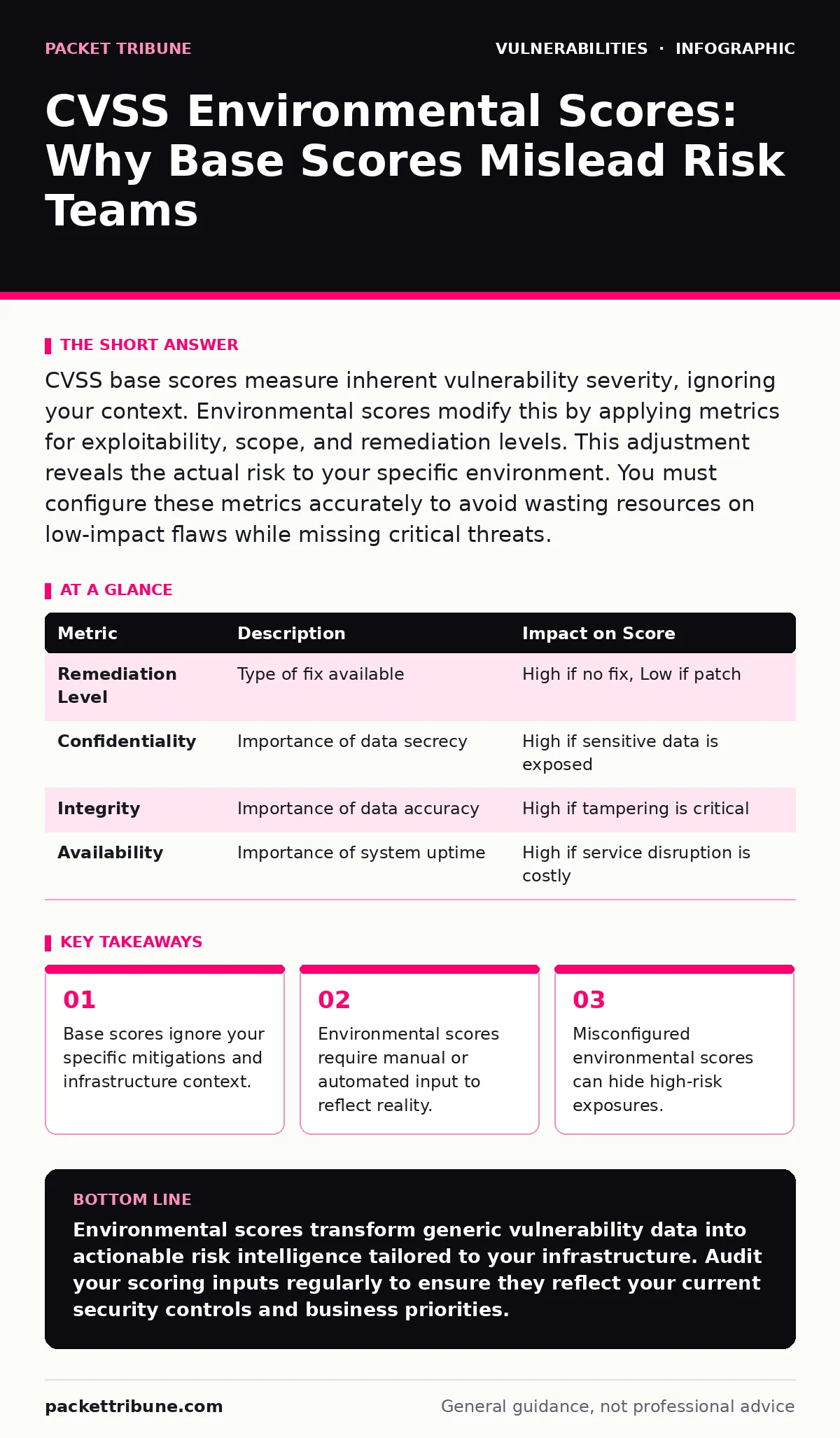
CVSS base scores measure inherent vulnerability severity, ignoring your context. Environmental scores modify this by applying metrics for exploitability, scope, and remediation levels. This adjustment reveals the actual risk to your specific environment. You must configure these metrics accurately to avoid wasting resources on low-impact flaws while missing critical threats.
What is the difference between base and environmental scores?
Base scores represent the intrinsic severity of a vulnerability, independent of any specific environment. Environmental scores modify this base value by applying metrics that reflect your unique infrastructure, security controls, and operational context. You use environmental scores to translate abstract technical flaws into concrete business risk. Base scores remain static across all organisations, while environmental scores vary based on how you deploy and protect your assets.
Why do environmental scores change over time?
Environmental scores fluctuate as your infrastructure changes or as vendors release patches. The temporal metric within the environmental scoring model accounts for the availability of remediations, workarounds, or mitigations. If you deploy a security patch, the score decreases. If a vendor releases only a temporary workaround, the score may drop slightly but not fully. This dynamic nature ensures the score reflects the current state of your defence rather than a historical snapshot.
How does the remediation level metric affect scoring?
The remediation level metric adjusts the score based on the type of fix available. A full vendor patch reduces the score significantly because it eliminates the vulnerability at the source. A temporary workaround, such as a configuration change or a script, provides partial mitigation and lowers the score less. If no fix exists, the score remains high, indicating persistent risk. This distinction helps you prioritise immediate actions versus long-term remediation strategies.
What role do confidentiality, integrity and availability requirements play?
These metrics adjust the score based on the impact of the vulnerability on your specific assets. You assign a value representing the importance of data confidentiality, system integrity, and service availability in your context. For example, a database server holding customer records has a high confidentiality requirement. A public-facing web server may have lower confidentiality but higher availability requirements. Misaligning these values with your actual business needs distorts your risk assessment.
Can environmental scores replace qualitative risk assessment?
Environmental scores provide a quantitative framework but cannot replace human judgment entirely. They lack context regarding business impact, legal consequences, and reputational damage. A low environmental score might still represent a critical risk if the asset holds highly sensitive data. You must combine these scores with qualitative factors to form a complete picture. Relying solely on automated scores can lead to blind spots in your security posture.
See also: CVE Numbering Authorities Explained: How Vulnerability IDs Are Assigned · Emergency Patching: How to Fix Critical Flaws Without Breaking Production
How do you calculate environmental scores manually?
Manual calculation involves adjusting the base score using the environmental metrics defined in the CVSS specification. You start with the base score and apply modifiers for exploitability, scope, and impact requirements. You must also consider temporal factors like patch availability. This process requires detailed knowledge of your infrastructure and the vulnerability. Most organisations use automated tools to perform these calculations, reducing human error and saving time.
Why might automated tools miscalculate environmental scores?
Automated tools rely on accurate input data to calculate environmental scores. If the tool does not detect your specific mitigations, such as web application firewalls or network segmentation, it will overestimate the risk. Conversely, if it fails to identify a critical asset, it will underestimate the impact. Regular validation of tool configurations and asset inventories is necessary to ensure accuracy. Inaccurate data leads to inaccurate scores, wasting your security team's effort.
How do environmental scores integrate with EPSS data?
EPSS (Exploit Prediction Scoring System) provides a probability that a vulnerability will be exploited in the wild. Combining EPSS with CVSS environmental scores offers a more nuanced view of risk. You can prioritise vulnerabilities that have both high environmental impact and high exploitation probability. This integration helps you focus on threats that are likely to occur and matter to your organisation. It moves beyond theoretical severity to practical likelihood.
| Metric | Description | Impact on Score |
|---|---|---|
| Remediation Level | Type of fix available | High if no fix, Low if patch |
| Confidentiality | Importance of data secrecy | High if sensitive data is exposed |
| Integrity | Importance of data accuracy | High if tampering is critical |
| Availability | Importance of system uptime | High if service disruption is costly |
What are the hidden costs of ignoring environmental scoring?
Ignoring environmental scoring leads to inefficient resource allocation. Your team may spend hours patching low-risk vulnerabilities while critical, high-impact flaws remain unaddressed. This misalignment increases the likelihood of a successful breach. It also creates alert fatigue, as security teams drown in noise from low-priority issues. Properly configured environmental scores streamline your vulnerability management process, ensuring you focus on what truly matters.
How do you validate the accuracy of your environmental scores?
Validation involves comparing calculated scores against known risk assessments and incident history. You should regularly audit your input data, ensuring that asset classifications and mitigation statuses are correct. Peer reviews of high-score items can identify discrepancies. Testing your prioritisation logic against simulated attacks can reveal gaps. Continuous improvement of your scoring methodology ensures it remains relevant and effective over time.
Key takeaways
- Base scores ignore your specific mitigations and infrastructure context.
- Environmental scores require manual or automated input to reflect reality.
- Misconfigured environmental scores can hide high-risk exposures.
- Integrating EPSS data with environmental scores improves prioritisation.
Environmental scores transform generic vulnerability data into actionable risk intelligence tailored to your infrastructure. Audit your scoring inputs regularly to ensure they reflect your current security controls and business priorities.
Frequently asked questions
Do environmental scores change if I add a WAF?
Yes, adding a Web Application Firewall is a mitigation that should lower the environmental score by reducing exploitability.
Can I use environmental scores for compliance reporting?
Environmental scores can support compliance by demonstrating risk-based prioritisation, but check specific regulatory requirements for accepted frameworks.
How often should I update environmental metrics?
Update metrics whenever your infrastructure changes, patches are applied, or business priorities shift, typically at least quarterly.
Are environmental scores standardised across all tools?
The CVSS specification is standard, but individual tools may implement calculations differently, leading to slight variations in final scores.
How this guide was produced: written by the Packet Tribune editorial team with AI assistance, checked against the public references listed below, and reviewed when the facts change. See our editorial policy or report an error.