Prevent Apache Struts Vulnerabilities: Effective Mitigation Strategies
Input validation at the framework level neutralises remote code execution risks that perimeter filters routinely miss in modern web applications.

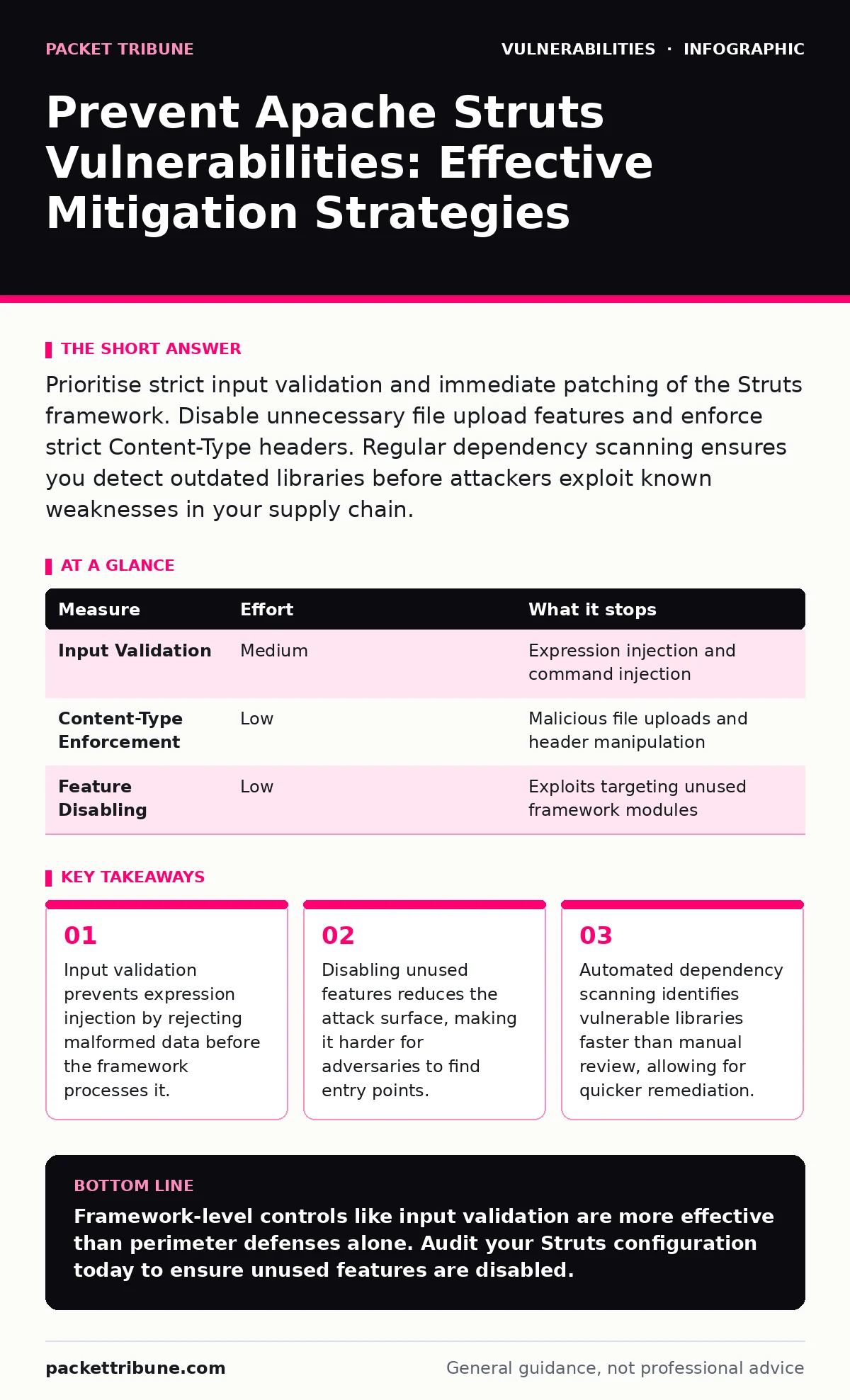
Prioritise strict input validation and immediate patching of the Struts framework. Disable unnecessary file upload features and enforce strict Content-Type headers. Regular dependency scanning ensures you detect outdated libraries before attackers exploit known weaknesses in your supply chain.
Prioritise Input Validation Mechanisms
Apache Struts vulnerabilities often stem from improper handling of user-supplied data. The framework parses input to route requests, but malformed data can trigger unintended code execution. You must validate all incoming parameters against expected formats. Reject any input that contains unexpected characters or structures. This stops expression injection attacks at the earliest stage. Validation should occur before the framework attempts to interpret the data.
Suppose an attacker sends a request with embedded script instructions. Without validation, the framework executes these instructions. With strict validation, the request fails immediately. This prevents the initial breach. Validation rules must be comprehensive and updated regularly. They should cover alphanumeric constraints, length limits, and specific character sets. Do not rely on blacklisting bad characters alone. Whitelisting allowed patterns is more secure and predictable.
Enforce Strict Content-Type Headers
Many Struts exploits rely on uploading malicious files disguised as legitimate documents. The server processes these files based on their declared type. Attackers manipulate headers to bypass security checks. You must enforce strict Content-Type validation on all file uploads. Verify that the actual file content matches the declared header. Reject requests where the type is ambiguous or mismatched. This adds a layer of defence against file-based attacks.
Imagine a user uploads a script file named with an image extension. The header claims it is an image, but the content is executable. Strict validation detects this discrepancy. The server rejects the file before storing it. This prevents the attacker from hosting malicious code on your server. Combine header validation with file signature checks. Ensure the file structure matches its declared type. This dual approach significantly reduces the risk of successful uploads.
Disable Unnecessary Framework Features
Apache Struts offers numerous features, but not all are required for every application. Unused features increase the attack surface. You should disable any feature you do not actively use. This includes dynamic method invocation and certain plugin modules. Each enabled feature introduces potential vulnerabilities. Reducing enabled features limits the paths an attacker can exploit. Review your configuration files regularly. Remove any settings that enable unused functionality.
Suppose your application does not require file upload capabilities. Disabling the upload plugin removes an entire class of vulnerabilities. Attackers cannot exploit upload flaws if the feature is inactive. This simplifies your security posture. It also reduces the complexity of your application. Fewer features mean fewer configuration options to secure. This makes maintenance easier and reduces the chance of misconfiguration.
| Measure | Effort | What it stops |
|---|---|---|
| Input Validation | Medium | Expression injection and command injection |
| Content-Type Enforcement | Low | Malicious file uploads and header manipulation |
| Feature Disabling | Low | Exploits targeting unused framework modules |
Implement Automated Dependency Scanning
Your application depends on many third-party libraries. These libraries may contain known vulnerabilities. Manual tracking is inefficient and error-prone. You should implement automated dependency scanning. This process continuously checks your libraries against vulnerability databases. It alerts you when new vulnerabilities are discovered. This allows you to patch issues before they are exploited. Integrate scanning into your development pipeline. Run scans before each deployment.
Imagine a library you use receives a critical update. Automated scanning detects this change immediately. You receive an alert and can update the library. Without automation, you might miss the update for months. Attackers could exploit the known vulnerability during this window. Regular scanning ensures your dependencies remain secure. It also helps you manage the lifecycle of your software components.
Apply Immediate Patching Protocols
Vulnerabilities in Apache Struts are often patched quickly by the community. Delaying updates leaves your application exposed. You must establish a protocol for immediate patching. Test patches in a staging environment first. Verify that they do not break existing functionality. Then deploy them to production. Automate the patching process where possible. This reduces the time between vulnerability disclosure and remediation. Speed is critical in mitigating known risks.
Suppose a high-severity vulnerability is announced. Your protocol dictates testing the patch within hours. You deploy the fix within a day. This minimises the window of exposure. Attackers often exploit new vulnerabilities quickly. Delaying patching increases the risk of a breach. Maintain a schedule for regular updates. Include security patches in your routine maintenance. This ensures your application stays protected against emerging threats.
See also: Dependency Scanning Implementation: From Policy to Pipeline
Restrict File Upload Capabilities
File uploads are a common vector for attacks. They allow attackers to place malicious code on your server. You should restrict file upload capabilities as much as possible. Limit the types of files users can upload. Use server-side validation to check file contents. Store uploaded files outside the web root. This prevents direct execution of uploaded scripts. Implement strict access controls on upload directories. Ensure only authorised users can access them.
Imagine an attacker uploads a web shell script. If stored in the web root, they can execute it directly. By storing files outside the web root, you prevent this. The script cannot be accessed via a URL. This adds a significant barrier to exploitation. Combine this with strict access controls. Ensure the application server cannot execute files from the upload directory. This layered approach enhances security.
Conduct Regular Security Audits
Regular audits identify weaknesses in your implementation. They help you stay ahead of evolving threats. You should conduct security audits periodically. Focus on your Struts configuration and input handling. Check for misconfigurations and outdated libraries. Review your logging and monitoring capabilities. Ensure you detect suspicious activity promptly. Audits provide a holistic view of your security posture. They highlight areas for improvement and reinforce best practices.
Suppose an audit reveals a misconfigured upload handler. You correct the configuration immediately. This prevents potential exploitation. Audits also help you verify that your controls are effective. They ensure your security measures align with industry standards. Regular reviews keep your application secure over time. They adapt to new threats and technologies. This proactive approach reduces the likelihood of a breach.
Monitor for Suspicious Activity
Monitoring helps you detect attacks in real-time. It allows you to respond quickly to threats. You should monitor your application for unusual patterns. Look for repeated failed login attempts. Watch for unusual file uploads. Track requests with malformed headers. Set up alerts for suspicious activity. Investigate any anomalies promptly. Monitoring provides early warning of potential breaches. It enables you to take action before damage occurs.
Imagine a sudden spike in failed requests. Your monitoring system alerts you immediately. You investigate and find an attack attempt. You block the attacker's IP address. This prevents further attempts. Monitoring also helps you understand attack trends. It informs your security strategy. Ensure your logs are comprehensive and retained for analysis. This supports forensic investigations if needed.
Key takeaways
- Input validation prevents expression injection by rejecting malformed data before the framework processes it.
- Disabling unused features reduces the attack surface, making it harder for adversaries to find entry points.
- Automated dependency scanning identifies vulnerable libraries faster than manual review, allowing for quicker remediation.
Framework-level controls like input validation are more effective than perimeter defenses alone. Audit your Struts configuration today to ensure unused features are disabled.
Frequently asked questions
How do I know if my Apache Struts version is vulnerable?
Check the official Apache Struts advisories for known vulnerabilities. Compare your version number with the affected versions listed.
Can a WAF completely protect against Struts exploits?
No, WAFs can miss sophisticated attacks. Framework-level controls are necessary for comprehensive protection.
How often should I scan for dependencies?
Scan continuously, ideally integrated into your development pipeline. Run scans before each deployment to catch new vulnerabilities.
What is the first step in securing Struts?
Disable any unused features and enforce strict input validation on all user-supplied data.
How this guide was produced: written by the Packet Tribune editorial team with AI assistance, checked against the public references listed below, and reviewed when the facts change. See our editorial policy or report an error.