Implementing Compensating Controls: A Practical Step-by-Step Framework
Compensating controls reduce risk exposure when primary security measures fail, provided they are formally validated and continuously monitored for effectiveness.

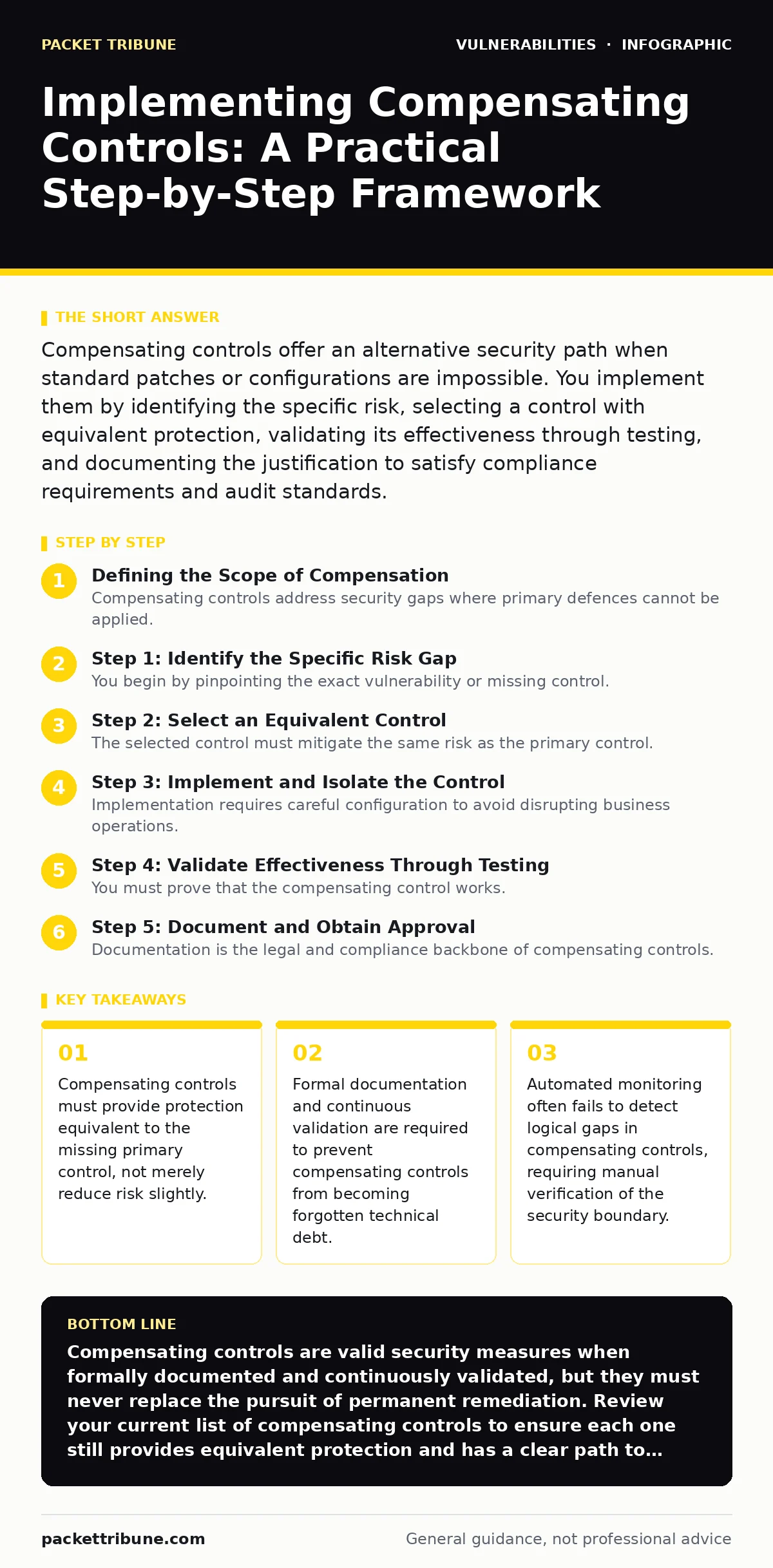
Compensating controls offer an alternative security path when standard patches or configurations are impossible. You implement them by identifying the specific risk, selecting a control with equivalent protection, validating its effectiveness through testing, and documenting the justification to satisfy compliance requirements and audit standards.
Defining the Scope of Compensation
Compensating controls address security gaps where primary defences cannot be applied. These gaps arise from legacy systems that cannot be patched, operational constraints that prevent network segmentation, or software dependencies that introduce unavoidable vulnerabilities. You must distinguish between a temporary workaround and a formal compensating control. A workaround lacks governance and often degrades security over time. A formal control is documented, tested, and reviewed. The goal is to maintain the same level of risk protection that the primary control would have provided. This requires a precise understanding of the attack vector and the specific data or system at risk.
Imagine a critical database running on an operating system that no longer receives security updates. You cannot apply the vendor’s patch. The primary control is missing. A compensating control might isolate this system on a separate network segment with strict access controls. This isolation prevents remote exploitation even if the underlying OS remains vulnerable. The control compensates for the lack of patching by removing the attack path.
Step 1: Identify the Specific Risk Gap
You begin by pinpointing the exact vulnerability or missing control. Vague descriptions like "secure the server" fail because they do not define the boundary. You must identify the specific CVE or configuration error that cannot be remediated through standard means. This step often intersects with risk-based vulnerability management, where prioritisation depends on the likelihood of exploitation and the value of the asset. You document why the primary control is infeasible. Common reasons include application incompatibility, vendor support termination, or operational downtime constraints. Without this justification, the control is merely a guess.
- Document the specific vulnerability or missing control.
- Explain why the standard remediation is impossible.
- Define the assets and data exposed by this gap.
Step 2: Select an Equivalent Control
The selected control must mitigate the same risk as the primary control. If the primary control was encryption at rest, a compensating control might be physical security combined with strict access logs. You evaluate options based on their ability to stop the specific attack vector. Network segmentation is a common choice for systems that cannot be patched.
It limits lateral movement and restricts access to authorised users only. You must ensure the new control does not introduce new vulnerabilities. For instance, adding a proxy server to inspect traffic might expose the proxy to attack. You review HTTP security headers to ensure any new web-facing components are configured securely.
Step 3: Implement and Isolate the Control
Implementation requires careful configuration to avoid disrupting business operations. You deploy the control in a way that enforces the security boundary. If using network segmentation, you configure firewalls to allow only necessary traffic. You disable unused ports and services. You ensure that the control is active before exposing the vulnerable system to any network. This step often involves coordination with network engineers and system administrators. You test the configuration in a non-production environment first. This prevents accidental lockouts or service disruptions. You verify that the control blocks the intended attack vector while allowing legitimate traffic.
- Configure the control to block the specific attack path.
- Test the configuration in a staging environment.
- Verify that legitimate business traffic is not disrupted.
Step 4: Validate Effectiveness Through Testing
You must prove that the compensating control works. This involves active testing, not just configuration checks. You simulate the attack vector that the missing primary control would have stopped. If the control is network segmentation, you attempt to access the vulnerable system from an unauthorised network zone. You verify that the connection is blocked. You also check for bypass methods. Attackers often look for alternative paths, such as DNS tunnelling or ICMP redirection. You ensure these paths are also blocked. This validation confirms that the risk has been reduced to an acceptable level. You document the test results and the date of validation.
See also: How to Run Tabletop Exercises: A Practical Implementation Framework · How To Read VEX Documents Without Misinterpreting Risk
Step 5: Document and Obtain Approval
Documentation is the legal and compliance backbone of compensating controls. You record the risk, the reason for the exemption, the chosen control, and the validation results. This record serves as evidence for auditors and internal reviews. You obtain approval from the relevant risk owner or security committee. This approval confirms that the organisation accepts the residual risk. Without formal approval, the control is unauthorised and may be removed during routine maintenance. You store this documentation in a centralised repository accessible to security and compliance teams. This transparency ensures accountability and facilitates future reviews.
Step 6: Monitor and Review Continuously
Compensating controls are not static. They degrade as systems change, new vulnerabilities emerge, or business requirements evolve. You establish a schedule for regular reviews. This includes checking that the control is still active and effective. You monitor logs for any signs of circumvention. If the underlying system changes, you re-evaluate the control. For example, if a new application is added to the segmented network, you verify that the segmentation rules still apply. You also track EPSS score trends to understand if the likelihood of exploitation has increased. If the risk profile changes, you update the control or seek a permanent remediation.
- Schedule quarterly reviews of all compensating controls.
- Monitor logs for attempted bypasses or policy violations.
- Update documentation when systems or risks change.
Verifying Long-Term Efficacy
Over time, compensating controls can become outdated or misconfigured. You implement automated alerts for configuration drift. If a firewall rule is changed, you receive an immediate notification. You also conduct periodic audits to ensure that the control still provides equivalent protection. This might involve re-testing the attack vector.
You compare the current state against the original justification. If the original reason for the exemption no longer applies, you remove the compensating control and implement the primary control. This lifecycle approach ensures that security posture remains strong. You integrate this process with your dependency updates workflow to catch related risks early.
Common Pitfalls in Implementation
Many organisations fail to maintain compensating controls because they treat them as permanent solutions. This leads to technical debt and increased risk. You must avoid this by setting a clear expiration date or trigger for review. Another common error is assuming that one control compensates for multiple unrelated vulnerabilities. Each gap requires a specific analysis. You also avoid relying solely on administrative controls, such as policies, without technical enforcement. Policies are easily ignored. Technical controls, such as access lists, are harder to bypass. You balance both, but prioritise technical enforcement.
Integrating with Broader Security Strategies
Compensating controls fit within a larger security framework. They complement other measures like emergency patching for critical vulnerabilities that cannot wait for the regular cycle. They also relate to exposed admin panels, where strict access controls compensate for the lack of additional authentication factors. You ensure that compensating controls do not conflict with other security measures. For example, a compensating firewall rule should not block traffic required by an intrusion detection system. You coordinate with different security teams to ensure alignment. This holistic view prevents gaps and overlaps.
Final Checklist for Deployment
Before finalising the implementation, you run through a final checklist. This ensures that no step was missed and that the control is ready for production. You verify that all stakeholders have reviewed and approved the plan. You confirm that monitoring is in place. You ensure that documentation is complete and accessible. This final step reduces the risk of deployment errors and ensures compliance. You also prepare a rollback plan in case the control causes unexpected issues. This preparation minimises downtime and maintains business continuity.
- Confirm approval from risk owners.
- Verify monitoring and alerting are active.
- Ensure documentation is stored centrally.
- Test rollback procedures.
Key takeaways
- Compensating controls must provide protection equivalent to the missing primary control, not merely reduce risk slightly.
- Formal documentation and continuous validation are required to prevent compensating controls from becoming forgotten technical debt.
- Automated monitoring often fails to detect logical gaps in compensating controls, requiring manual verification of the security boundary.
Compensating controls are valid security measures when formally documented and continuously validated, but they must never replace the pursuit of permanent remediation. Review your current list of compensating controls to ensure each one still provides equivalent protection and has a clear path to eventual removal.
Frequently asked questions
How long can a compensating control remain in place?
There is no fixed time limit, but it should be reviewed regularly and removed as soon as the primary control can be implemented. Long-term use increases risk and technical debt.
Can administrative policies serve as compensating controls?
Administrative policies alone are rarely sufficient. They should be combined with technical controls to ensure enforcement. Policies can be ignored, but technical controls are harder to bypass.
Do compensating controls satisfy compliance requirements?
Yes, if they are documented, validated, and approved by the relevant authority. Auditors will scrutinise the justification and effectiveness, so thorough documentation is critical.
How do you handle compensating controls for cloud environments?
Cloud environments offer native tools for segmentation and access control. You leverage these tools to implement compensating controls, ensuring they align with the shared responsibility model.
How this guide was produced: written by the Packet Tribune editorial team with AI assistance, checked against the public references listed below, and reviewed when the facts change. See our editorial policy or report an error.