Malicious Typosquatted Packages: How Spelling Errors Compromise Software Supply Chains
Typosquatting exploits human error in package resolution, allowing attackers to inject code before security tools inspect the legitimate software.

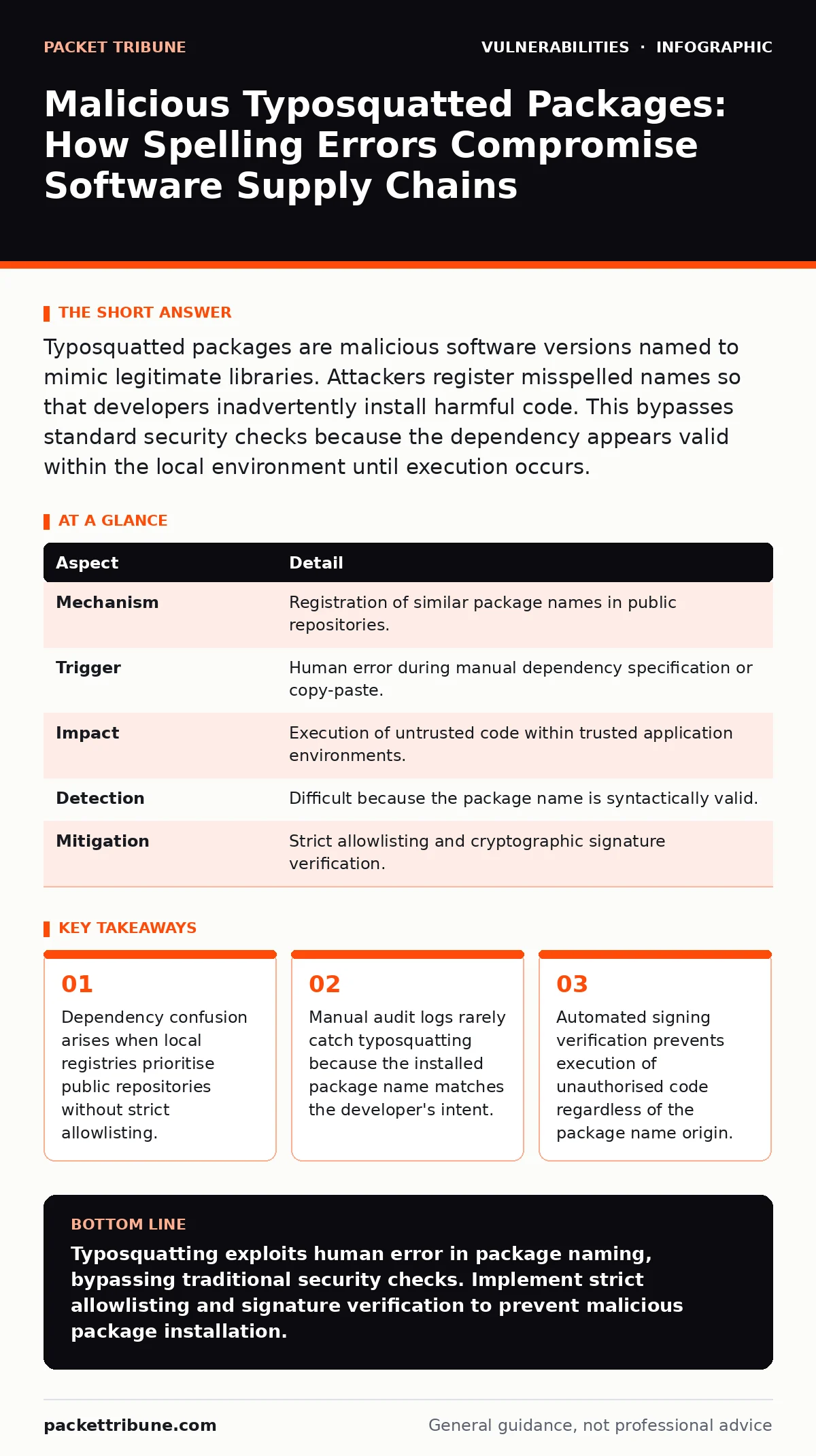
Typosquatted packages are malicious software versions named to mimic legitimate libraries. Attackers register misspelled names so that developers inadvertently install harmful code. This bypasses standard security checks because the dependency appears valid within the local environment until execution occurs.
Understanding Typosquatting in Software Dependencies
Typosquatting in software supply chains occurs when an attacker registers a package name that closely resembles a legitimate library. The attacker hopes a developer will misspell the package name during installation. The package manager then retrieves the malicious version instead of the intended one. This technique exploits the cognitive load of developers who frequently install new dependencies. The malicious package often contains code that exfiltrates credentials or installs further malware. The damage occurs before the developer realises the incorrect package was installed.
| Aspect | Detail |
|---|---|
| Mechanism | Registration of similar package names in public repositories. |
| Trigger | Human error during manual dependency specification or copy-paste. |
| Impact | Execution of untrusted code within trusted application environments. |
| Detection | Difficult because the package name is syntactically valid. |
| Mitigation | Strict allowlisting and cryptographic signature verification. |
How Package Resolution Enables Attackers
Package managers resolve names by searching configured repositories. If a developer specifies a misspelled name, the manager searches for that exact string. The attacker has previously published a package with that misspelled name. The package manager finds the malicious package and downloads it. The installation proceeds without warning because the name is valid. This process bypasses traditional security controls that rely on package name reputation. The attacker gains a foothold in the development environment. The malicious code runs with the same permissions as the legitimate application.
Imagine a developer installing a popular data processing library. They type a slightly incorrect name due to a typo. The package manager finds a package with that incorrect name. The developer assumes the installation was successful. The malicious package executes code that steals environment variables. The developer continues working, unaware that their credentials are compromised. The attacker now has access to internal systems.
Who Is Affected by Typosquatting
Typosquatting affects any organisation that uses open-source software components. Developers who manually specify package names are the primary targets. Automated build pipelines can also be affected if they rely on fuzzy matching. Large enterprises with complex dependency trees face higher risks. The sheer volume of dependencies makes manual verification impossible. Small teams with limited security oversight are equally vulnerable. The attack vector does not depend on the size of the organisation. It depends on the diligence of the dependency management process.
The impact extends beyond the immediate developer. If the malicious package is included in a build artifact, it affects the entire deployment. Production systems may be compromised. Customer data may be exposed. The reputation of the organisation suffers. Trust in the software supply chain erodes. Recovery requires identifying all affected systems. This process is time-consuming and resource-intensive.
Common Forms of Package Spoofing
Attackers use various techniques to mimic legitimate packages. Simple misspellings are the most common form. Swapping adjacent keys on a keyboard creates plausible errors. Removing or adding a single character is another method. Attackers may also use homograph characters from different scripts. These characters look identical to Latin letters but are technically different. The package manager treats them as distinct names. The human eye sees them as the same name. This visual similarity confuses developers during manual reviews.
Another form involves leveraging popular package names with slight variations. Adding a prefix or suffix like "v2" or "official" can trick users. Attackers may also create packages with similar descriptions. The metadata appears legitimate. The code inside is malicious. This form relies on social engineering rather than technical exploitation. Developers trust the package because it appears to be an updated or official version.
What People Usually Get Wrong
Many organisations believe that using internal registries prevents typosquatting. This assumption is incorrect if the registry proxies public repositories. If the internal registry does not have the package, it may fetch it from the public source. The attacker's package may be available in the public source. The internal registry serves the malicious package to the developer. The developer assumes the package is safe because it came from the internal source. This false sense of security leads to lax verification practices.
Another common mistake is relying solely on version pinning. Pinning versions ensures reproducibility but does not prevent typosquatting. If the developer pins a misspelled name, the malicious package is installed consistently. The build process remains stable but insecure. Security tools may not flag the package because it is consistent with previous builds. The malicious code executes in every build. The organisation continues to deploy compromised software.
See also: Dependency Updates: Mechanism, Risk and Maintenance Strategy · Prevent Apache Struts Vulnerabilities: Effective Mitigation Strategies
Reducing Risk Through Strict Controls
Organisations must implement strict allowlisting for package dependencies. Only pre-approved packages should be allowed in build environments. This prevents the installation of unknown or misspelled packages. Developers must request new packages through a formal process. Security teams review the request before approval. This adds friction but significantly reduces risk. The process ensures that every package is vetted before use.
Cryptographic signing of packages provides another layer of protection. Developers and build systems should verify signatures before installation. If the signature is missing or invalid, the installation fails. This prevents execution of untrusted code. Even if a typosquatted package is downloaded, it cannot run without a valid signature. This mechanism shifts trust from the package name to the cryptographic key.
Integrating Typosquatting Prevention into CI/CD
Continuous integration pipelines should include checks for typosquatted packages. Automated tools can compare requested package names against known legitimate names. If a mismatch is detected, the build fails. This prevents malicious packages from entering the build artifact. The developer receives immediate feedback. They can correct the typo and retry the build. This automated check scales better than manual review.
Organisations should also monitor for new package registrations. Public repositories allow anyone to register new names. Attackers may register typosquatted names before developers use them. Monitoring services can alert security teams to suspicious registrations. Teams can proactively block these packages in their registries. This proactive approach reduces the window of opportunity for attackers. It requires ongoing effort but provides significant protection.
Refer to the publication's guide on VEX documents for managing known vulnerabilities in software components. VEX documents help track which vulnerabilities are actually exploitable in your environment. This reduces noise in security alerts. It allows teams to focus on high-risk issues. Typosquatting prevention complements vulnerability management. Both approaches strengthen the software supply chain.
Consider the related guide on API vulnerabilities for broader context on interface security. Typosquatting often targets libraries that interact with APIs. Securing the API endpoints reduces the impact of compromised libraries. This layered defence strategy improves overall security posture.
The Hidden Cost of Manual Audits
Manual audits of package dependencies are prone to error. Developers must read package names carefully. This is difficult when installing dozens of dependencies. Fatigue leads to missed typos. The cost of manual audits is high in terms of time and labour. It does not provide reliable protection. Automated tools are more consistent and scalable. They can check thousands of packages quickly. Human reviewers cannot match this speed or accuracy.
The hidden cost extends to incident response. When a typosquatted package is discovered, the response is complex. Teams must identify all affected systems. They must remove the malicious package. They must verify that no data was exfiltrated. This process disrupts development and operations. The financial impact can be significant. Prevention is far cheaper than remediation. Investing in automated controls pays off over time.
Key takeaways
- Dependency confusion arises when local registries prioritise public repositories without strict allowlisting.
- Manual audit logs rarely catch typosquatting because the installed package name matches the developer's intent.
- Automated signing verification prevents execution of unauthorised code regardless of the package name origin.
Typosquatting exploits human error in package naming, bypassing traditional security checks. Implement strict allowlisting and signature verification to prevent malicious package installation.
Frequently asked questions
How do I detect typosquatted packages in my system?
Use automated tools that compare installed package names against a list of known legitimate names. Look for discrepancies in package metadata and code content.
Can internal registries prevent typosquatting?
Internal registries can prevent typosquatting if they do not proxy public repositories for missing packages. Strict allowlisting is required to ensure only vetted packages are available.
What is the difference between typosquatting and dependency confusion?
Typosquatting involves misspelled package names. Dependency confusion involves attackers uploading packages with legitimate names to public repositories to exploit resolution priority.
Should I pin package versions to prevent typosquatting?
Pinning versions ensures consistency but does not prevent typosquatting. If the pinned name is misspelled, the malicious package will be installed consistently.
How this guide was produced: written by the Packet Tribune editorial team with AI assistance, checked against the public references listed below, and reviewed when the facts change. See our editorial policy or report an error.