Containers vs Virtual Machines: Architecture, Security and Cost Trade-offs
Containers share the host kernel to save resources, while virtual machines emulate full hardware to provide stronger isolation boundaries.

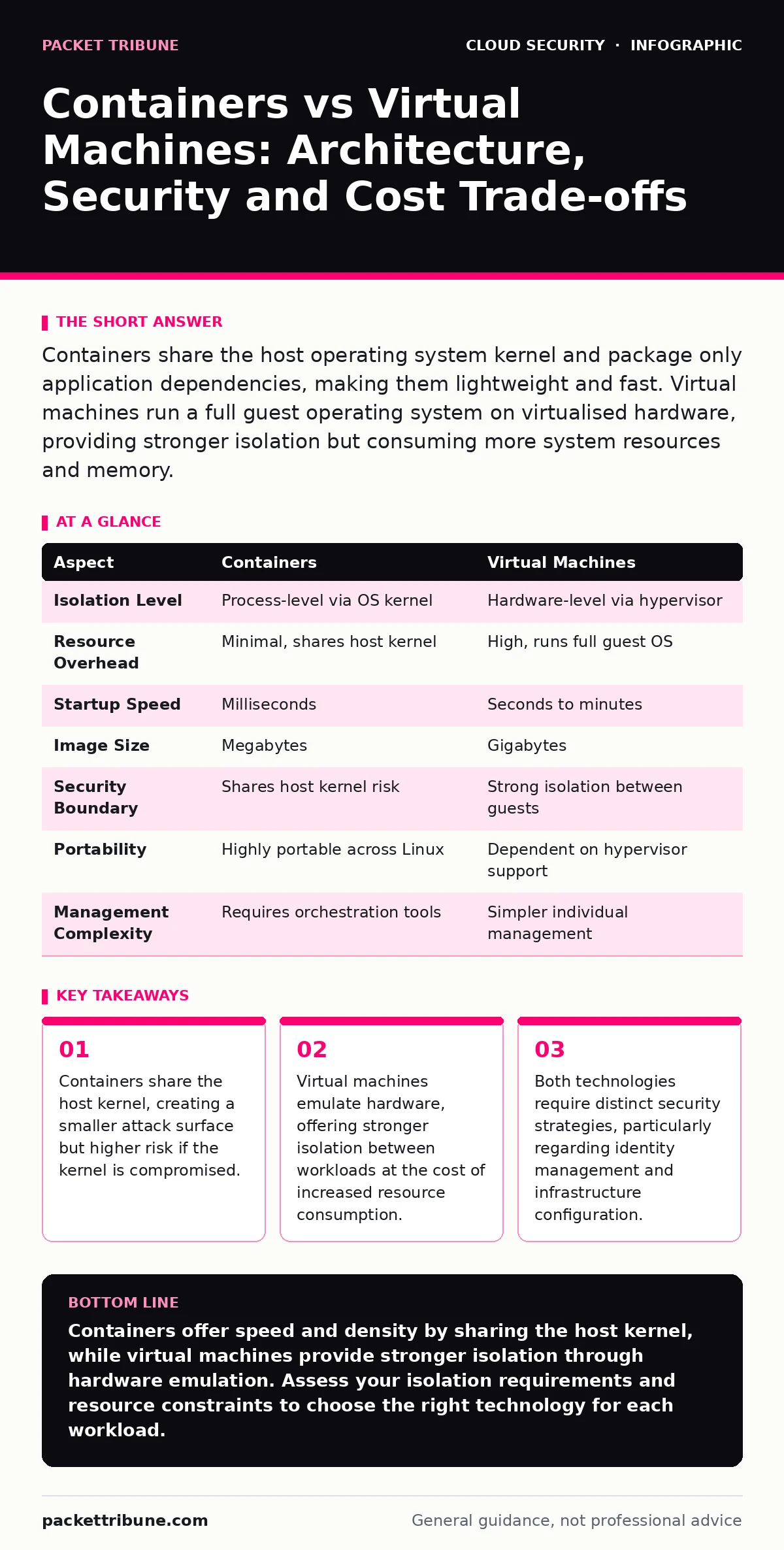
Containers share the host operating system kernel and package only application dependencies, making them lightweight and fast. Virtual machines run a full guest operating system on virtualised hardware, providing stronger isolation but consuming more system resources and memory.
The Core Architectural Difference
Containers and virtual machines address the same problem of application isolation but use fundamentally different mechanisms. A container shares the host operating system kernel and packages only the application code, libraries and dependencies. It runs as a standard process on the host, starting in milliseconds and consuming minimal memory. A virtual machine uses a hypervisor to emulate a complete physical server, including its own guest operating system. This emulation provides strong isolation because each machine runs independently, but it requires significant CPU and memory overhead for each instance.
What a Container Actually Is
A container is an isolated user space instance. It relies on kernel features such as namespaces for resource isolation and control groups for resource limits. The container image contains everything needed to run the application, but it does not include an operating system kernel. This design allows containers to be extremely lightweight. You can run dozens of containers on a single server without exhausting resources. However, because they share the host kernel, a vulnerability in the kernel affects all containers on that host. This shared dependency is the primary security trade-off you must manage.
What a Virtual Machine Actually Is
A virtual machine is a software-based emulation of physical computing hardware. The hypervisor sits between the hardware and the virtual machines, allocating CPU, memory and storage to each guest. Each virtual machine runs a full operating system, which means it has its own kernel, drivers and system libraries. This architecture provides a hard boundary between workloads. If one virtual machine is compromised, the attacker cannot easily access the host or other virtual machines. The cost is higher resource consumption and slower startup times, as the guest operating system must boot fully before applications can run.
Point-by-Point Comparison
| Aspect | Containers | Virtual Machines |
|---|---|---|
| Isolation Level | Process-level via OS kernel | Hardware-level via hypervisor |
| Resource Overhead | Minimal, shares host kernel | High, runs full guest OS |
| Startup Speed | Milliseconds | Seconds to minutes |
| Image Size | Megabytes | Gigabytes |
| Security Boundary | Shares host kernel risk | Strong isolation between guests |
| Portability | Highly portable across Linux | Dependent on hypervisor support |
| Management Complexity | Requires orchestration tools | Simpler individual management |
Choose Containers When
You should choose containers when your primary goals are density, speed and consistent deployment environments. Containers excel in microservices architectures where applications are broken into small, independent components. They allow you to scale individual services independently without provisioning entire servers. This approach supports rapid development cycles and continuous integration pipelines. You benefit from faster startup times and lower infrastructure costs because you run more workloads on fewer physical servers. This density is particularly valuable for stateless applications that do not require heavy data processing or strict hardware-level isolation.
See also: Infrastructure-as-Code Scanning Implementation Plan · DevSecOps vs SecDevOps: Why the Syntax Defines Your Security Posture
Choose Virtual Machines When
You should choose virtual machines when you need strong isolation, legacy application support or mixed operating system environments. Virtual machines are ideal for running applications that require specific kernel versions or hardware features not available through containerisation. They provide a clear boundary between different tenants or security zones, reducing the risk of lateral movement if one workload is compromised. This makes them suitable for multi-tenant environments where trust boundaries are strict. You also benefit from simpler debugging and monitoring because each virtual machine acts as an independent server with its own system logs and management interfaces.
Where They Overlap and Converge
The line between containers and virtual machines blurs with technologies like Firecracker and Kata Containers, which run containers inside lightweight micro-virtual machines. These solutions offer the speed and density of containers with the isolation of virtual machines. You still face the same fundamental security challenges regardless of the technology.
Identity sprawl remains a critical issue because both models create numerous endpoints that require authentication and authorisation. You must implement strict access controls and monitor for anomalies. Both technologies benefit from immutable infrastructure practices, where instances are replaced rather than patched, reducing configuration drift and long-term security risks.
Security Implications for Both
Both containers and virtual machines introduce complexity into your security posture. With containers, you must manage the security of the base images, the container runtime and the orchestration layer. Misconfigurations in orchestration tools can expose services to the internet or grant excessive privileges. With virtual machines, you must manage the hypervisor security, guest operating system updates and network segmentation.
Both approaches require robust logging and monitoring to detect unusual activity. You cannot rely on perimeter security alone. You must implement zero-trust principles, verifying every request regardless of its origin. This includes monitoring east-west traffic between workloads to detect lateral movement attempts.
Managing the Hybrid Reality
Most modern environments use both technologies. You might run containerised microservices for new applications while keeping legacy systems in virtual machines. This hybrid approach requires unified security management. You need tools that can monitor both containers and virtual machines consistently. This includes centralised logging, vulnerability scanning and policy enforcement.
You must also address the operational overhead of managing two different technologies. Training your team on both architectures is necessary to avoid gaps in security coverage. Consistent security policies across both environments reduce the risk of misconfiguration and ensure that new workloads are secured from day one.
Key takeaways
- Containers share the host kernel, creating a smaller attack surface but higher risk if the kernel is compromised.
- Virtual machines emulate hardware, offering stronger isolation between workloads at the cost of increased resource consumption.
- Both technologies require distinct security strategies, particularly regarding identity management and infrastructure configuration.
Containers offer speed and density by sharing the host kernel, while virtual machines provide stronger isolation through hardware emulation. Assess your isolation requirements and resource constraints to choose the right technology for each workload.
Frequently asked questions
Are containers more secure than virtual machines?
Containers offer a smaller attack surface due to fewer components, but they share the host kernel, which creates a single point of failure. Virtual machines provide stronger isolation, making them more secure against host-level attacks but more complex to manage.
Can I run containers inside virtual machines?
Yes, this is a common pattern. You run virtual machines on physical servers and then run containers inside those virtual machines. This combines the isolation of virtual machines with the agility of containers, though it adds management complexity.
Do I need a hypervisor for containers?
No, containers do not require a hypervisor. They run directly on the host operating system kernel. Virtual machines require a hypervisor to emulate hardware and manage resource allocation for each guest operating system.
How do I secure both containers and virtual machines?
Implement consistent security policies across both technologies. Use immutable infrastructure, scan images and templates for vulnerabilities, enforce strict network segmentation and monitor runtime
How this guide was produced: written by the Packet Tribune editorial team with AI assistance, checked against the public references listed below, and reviewed when the facts change. See our editorial policy or report an error.