Banking Trojans: How They Steal Credentials and How to Stop Them
Banking malware hides in legitimate processes, stealing credentials by injecting code into banking apps rather than stealing saved passwords.

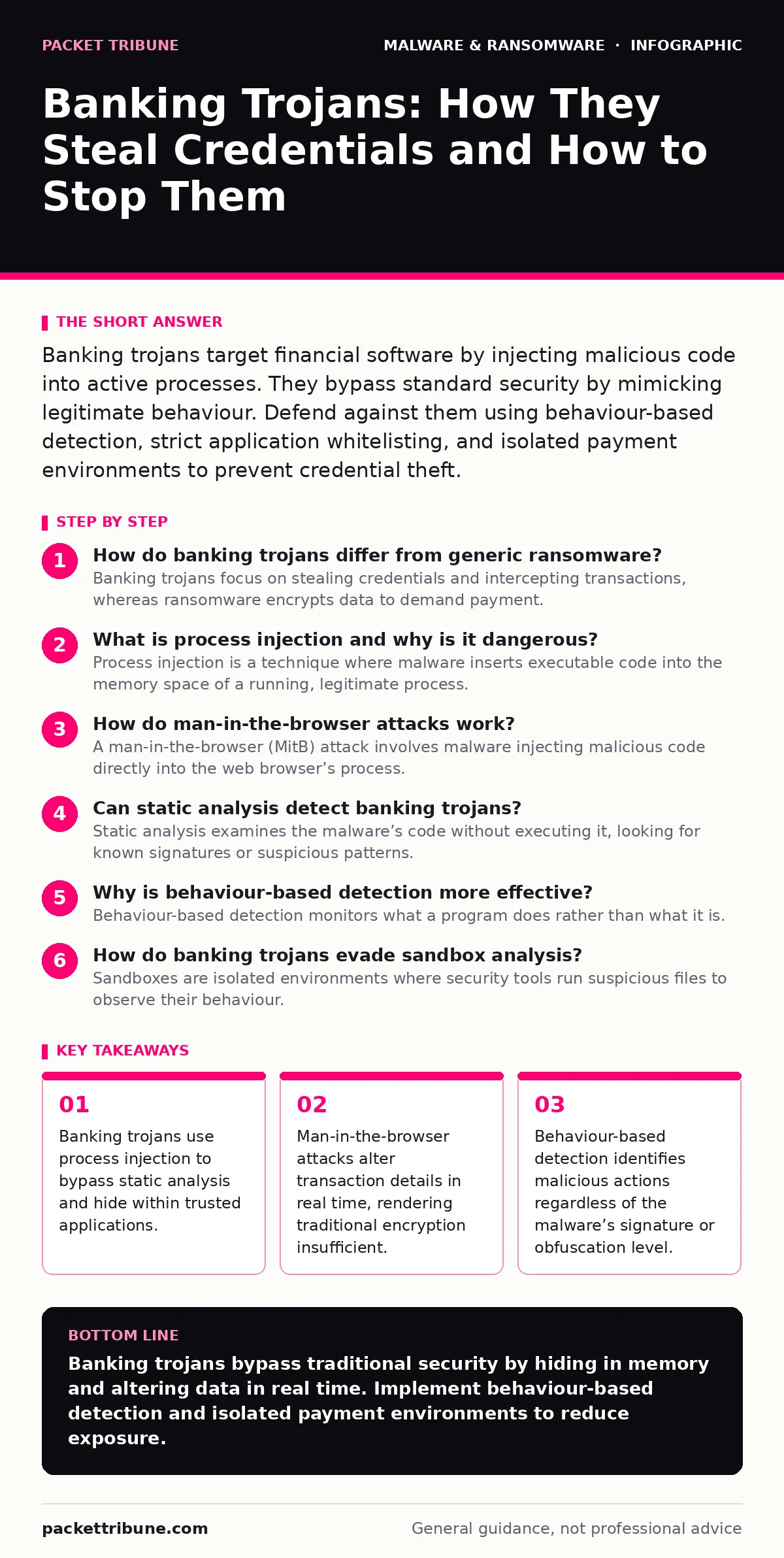
Banking trojans target financial software by injecting malicious code into active processes. They bypass standard security by mimicking legitimate behaviour. Defend against them using behaviour-based detection, strict application whitelisting, and isolated payment environments to prevent credential theft.
How do banking trojans differ from generic ransomware?
Banking trojans focus on stealing credentials and intercepting transactions, whereas ransomware encrypts data to demand payment. The goal of a banking trojan is stealth and continuity, not destruction. You want the victim to remain unaware so they continue funding accounts or making transfers. This difference dictates the malware’s behaviour.
It avoids noisy encryption routines that trigger immediate alarms. Instead, it operates quietly within the operating system’s normal noise. This distinction matters for your detection strategy. You cannot rely on the same indicators for both. A ransomware hunt looks for mass file modification. A banking trojan hunt looks for subtle memory manipulation and network anomalies.
What is process injection and why is it dangerous?
Process injection is a technique where malware inserts executable code into the memory space of a running, legitimate process. Banking trojans use this to hide their activities behind trusted applications like web browsers or banking clients. The malicious code runs with the permissions of the legitimate process. This bypasses many security controls that monitor only known executable files. It also makes detection difficult because the malicious code exists only in memory. It leaves no footprint on the disk for traditional antivirus scanners to find. This technique is central to the success of modern banking malware. It turns your trusted software into a delivery vehicle for theft.
How do man-in-the-browser attacks work?
A man-in-the-browser (MitB) attack involves malware injecting malicious code directly into the web browser’s process. This allows the trojan to view and modify data before it is encrypted and sent to the bank. The malware can capture credentials as you type them. More dangerously, it can alter transaction details in real time. Suppose you attempt to send funds to your own savings account. The MitB module changes the recipient address to one controlled by the attacker. You see the correct address on your screen, but the bank receives the altered one. This happens entirely within your device, bypassing network-level security. It renders standard HTTPS encryption ineffective against the theft.
Can static analysis detect banking trojans?
Static analysis examines the malware’s code without executing it, looking for known signatures or suspicious patterns. Banking trojans often evade this through heavy obfuscation and packing. The code is scrambled or compressed, making it unreadable to simple scanners. Furthermore, banking trojans frequently update their code to change these signatures.
This cat-and-mouse game renders static analysis less reliable over time. You cannot rely on signature-based matching alone. For a deeper understanding of how analysts dissect these threats, refer to the guide on static malware analysis. It explains the limitations of non-executable inspection methods. Modern banking trojans are designed specifically to defeat this approach.
Why is behaviour-based detection more effective?
Behaviour-based detection monitors what a program does rather than what it is. It looks for suspicious actions, such as a browser process attempting to access clipboard data or modify system settings. This method catches zero-day threats that have no known signature. It identifies the intent behind the code. If a banking app suddenly tries to inject code into another process, the system flags it. This approach is resilient against code changes and obfuscation. The attacker can change the code’s appearance, but not its fundamental need to steal data. For a broader view of this strategy, see behavior-based detection. It shifts the focus from identity to action.
See also: Behavior-Based Detection for Small Business Security · Static Malware Analysis Checklist: Verify Threats Without Execution
How do banking trojans evade sandbox analysis?
Sandboxes are isolated environments where security tools run suspicious files to observe their behaviour. Banking trojans employ anti-analysis techniques to detect these environments. They check for virtual machine indicators, such as specific hardware signatures or lack of user interaction. If the malware detects it is in a sandbox, it remains dormant. It only activates when it senses a real user environment. This makes automated analysis ineffective. The malware stays hidden during the scan, then springs into action later. You must assume that automated sandboxing will not always reveal the full threat.
What role does malware obfuscation play?
Obfuscation scrambles code to make it difficult for humans and machines to understand. Banking trojans use multiple layers of obfuscation to hide their true purpose. This includes renaming variables, adding junk code, and encrypting strings. The goal is to confuse static analysis tools. It also makes reverse engineering time-consuming and expensive. For more on these techniques, read about malware obfuscation. It details how attackers protect their intellectual property. Your defenses must account for this complexity. You cannot expect to read the source code of every threat.
How can isolated payment environments help?
An isolated payment environment restricts access to banking applications to a secure, dedicated space. This prevents other applications, including malware, from interacting with the banking software. It limits the ability of trojans to inject code or capture screen data. Many modern mobile devices offer this through features like Samsung Knox or Apple’s Secure Enclave. On desktops, virtualisation can create a similar boundary. This isolation breaks the chain of attack. Even if the main operating system is compromised, the banking environment remains secure. It is a practical application of device hardening principles.
| Technique | Primary Goal | Evasion Method | Detection Difficulty |
|---|---|---|---|
| Process Injection | Hide in trusted apps | Memory-only execution | High |
| Man-in-the-Browser | Alter transactions | Real-time DOM manipulation | High |
| Obfuscation | Confuse analysts | Code scrambling | Medium |
| Sandbox Evasion | Avoid detection | Environment checks | Medium |
What is the impact of fileless malware on banking security?
Fileless malware resides entirely in memory, leaving no files on the disk. Banking trojans increasingly adopt this approach to avoid file-based detection. They use legitimate system tools, such as PowerShell or Windows Management Instrumentation, to execute their code. This technique blurs the line between legitimate administration and malicious activity. For more on this trend, see fileless malware. It explains how attackers abuse trusted system components. Defending against fileless threats requires deep visibility into process behaviour. You must monitor for unusual command-line arguments and memory access patterns.
How do fake software updates aid distribution?
Attackers often distribute banking trojans through fake software updates. Users are tricked into downloading malicious installers that mimic legitimate applications. These installers request elevated privileges, allowing the malware to embed itself deeply in the system. This social engineering vector exploits trust. Users expect updates to be safe and necessary. For insights on this vector, refer to fake software updates. It details how attackers mimic legitimate software. Vigilance in verifying update sources is critical. Always use official channels for software maintenance.
Key takeaways
- Banking trojans use process injection to bypass static analysis and hide within trusted applications.
- Man-in-the-browser attacks alter transaction details in real time, rendering traditional encryption insufficient.
- Behaviour-based detection identifies malicious actions regardless of the malware’s signature or obfuscation level.
Banking trojans bypass traditional security by hiding in memory and altering data in real time. Implement behaviour-based detection and isolated payment environments to reduce exposure.
Frequently asked questions
Can a banking trojan steal my credit card details?
Yes, if you enter them into a compromised banking portal or shopping site. The malware captures keystrokes or reads browser memory.
Is two-factor authentication enough to stop banking trojans?
No, some trojans can intercept and relay two-factor codes in real time. They may also inject fake 2FA prompts to trick you.
Do mobile banking apps face the same risks?
Yes, mobile banking trojans use accessibility features and overlay attacks to steal credentials. They exploit similar vulnerabilities to desktop variants.
How do I know if I have a banking trojan?
Look for unusual battery drain, unexpected pop-ups, or modified browser settings. However, advanced trojans may show no visible symptoms.
How this guide was produced: written by the Packet Tribune editorial team with AI assistance, checked against the public references listed below, and reviewed when the facts change. See our editorial policy or report an error.