XDR Implementation Checklist: Aligning Data, Detection and Response
Most organisations fail to derive value from extended detection and response because they ignore data normalisation and assume correlation equals causation.

Use this checklist to verify your XDR deployment covers data ingestion, behavioural logic and automated response. It ensures you move beyond siloed alerts to coordinated threat hunting, reducing noise while catching sophisticated attacks that bypass traditional perimeter defences.
Data Ingestion and Normalisation
Extended detection and response relies on aggregating telemetry from endpoints, networks, cloud workloads and email gateways. If your data sources remain siloed, the platform cannot correlate events across attack stages. You must ensure every agent sends standardised logs to a central engine.
- Define required telemetry sources: selecting only endpoints leaves network-based attacks invisible to the correlation engine.
- Verify log normalisation schemas: disparate formats prevent the engine from matching indicators of compromise across different data types.
- Check for data gaps in cloud environments: missing identity logs means you cannot trace privilege escalation in virtualised infrastructures.
- Ensure historical data retention: short retention windows hide the early stages of long-dwelling intrusions.
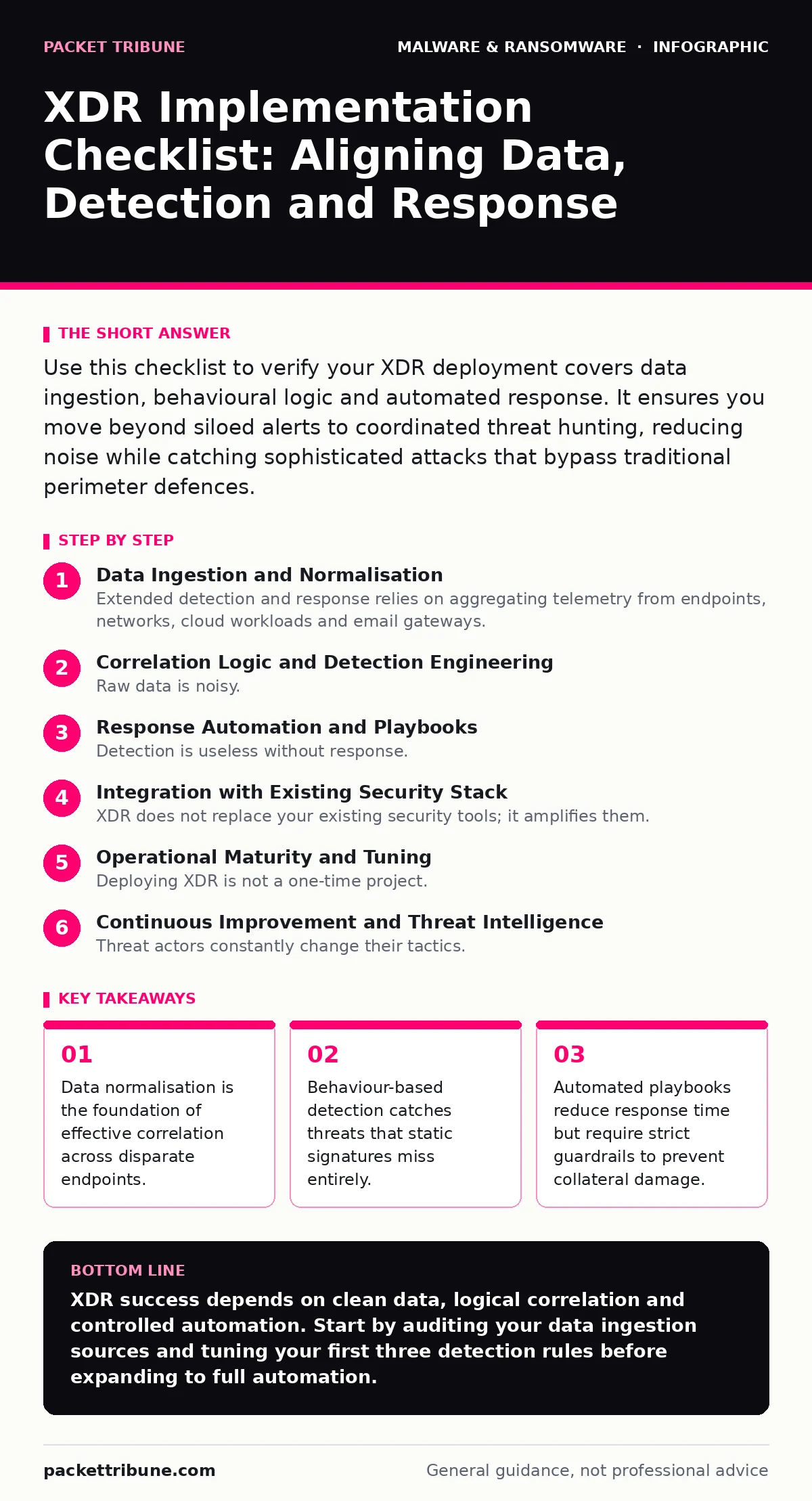
Correlation Logic and Detection Engineering
Raw data is noisy. The value of XDR lies in its ability to link unrelated events into a single incident narrative. You must configure rules that look for sequences rather than single anomalies. This approach is particularly effective against fileless malware, which leaves no executable on disk to trigger traditional file hashes.
- Tune baseline behavioural profiles: default thresholds generate excessive false positives in non-standard enterprise environments.
- Implement cross-domain correlation rules: linking a suspicious email click to subsequent process creation reveals the full kill chain.
- Review detection logic for malware obfuscation techniques: standard string matching fails when code is packed or encrypted at runtime.
- Validate logic against behavior-based detection standards: ensure rules trigger on actions, not just known signatures or file names.
Response Automation and Playbooks
Detection is useless without response. XDR platforms allow you to automate containment actions, such as isolating a host or disabling a user account. However, automation introduces risk. A misconfigured playbook could disrupt critical business operations during a false alarm. You need strict approval gates for high-impact actions.
- Define automated containment triggers: immediate isolation prevents lateral movement but may interrupt active user sessions.
- Establish human-in-the-loop approvals: requiring analyst verification for critical actions reduces the risk of operational disruption.
- Map playbooks to incident severity levels: minor threats should auto-resolve, while major incidents require manual triage and evidence preservation.
- Test playbook execution regularly: automated scripts often fail when system configurations change or dependencies are removed.
Integration with Existing Security Stack
XDR does not replace your existing security tools; it amplifies them. It must integrate with your security information and event management system, ticketing platforms and identity providers. Without these integrations, you create manual hand-off points that slow down response times and introduce human error.
- Verify SIEM integration capabilities: pushing enriched XDR alerts to your SIEM ensures a single pane of glass for all security data.
- Connect to identity providers: disabling compromised accounts directly from the XDR console speeds up containment of credential-based attacks.
- Link to vulnerability management tools: correlating exploits with known vulnerabilities helps prioritise patching efforts based on active threats.
- Ensure device hardening status is visible: knowing which devices lack basic security controls helps contextualise risk during an investigation.
Operational Maturity and Tuning
Deploying XDR is not a one-time project. It requires continuous tuning to adapt to evolving threats and changing business environments. You must regularly review alert quality, update detection rules and train analysts on new features. Neglecting this maintenance leads to alert fatigue and missed detections.
- Schedule monthly rule reviews: outdated rules create noise and obscure genuine threats.
- Conduct red team exercises: simulating attacks tests whether your XDR can detect and respond to novel techniques.
- Monitor analyst feedback loops: incorporating analyst notes into detection logic improves future alert accuracy.
- Review static malware analysis results: comparing XDR detections with static analysis findings helps validate the platform’s understanding of new samples.
See also: Data Breaches: The Hidden Costs and Real Mechanics of Exfiltration
Continuous Improvement and Threat Intelligence
Threat actors constantly change their tactics. Your XDR configuration must evolve to keep pace. Integrating external threat intelligence feeds helps you identify indicators of compromise before they hit your network. However, not all intelligence is equal. You must prioritise high-fidelity feeds that align with your industry and technology stack.
- Integrate high-fidelity threat feeds: generic feeds create noise; industry-specific feeds provide relevant context for your sector.
- Monitor for fake software updates: supply chain attacks often bypass traditional controls by leveraging trusted update mechanisms.
- Review banking trojans detection capabilities: if you handle financial transactions, ensure your rules catch screen scraping and overlay attacks.
- Engage with malware analysis communities: sharing anonymised telemetry helps improve community-wide detection capabilities.
Key takeaways
- Data normalisation is the foundation of effective correlation across disparate endpoints.
- Behaviour-based detection catches threats that static signatures miss entirely.
- Automated playbooks reduce response time but require strict guardrails to prevent collateral damage.
XDR success depends on clean data, logical correlation and controlled automation. Start by auditing your data ingestion sources and tuning your first three detection rules before expanding to full automation.
Frequently asked questions
How does XDR differ from EDR?
Extended detection and response aggregates data from endpoints, networks, cloud and email, whereas endpoint detection and response focuses solely on devices. XDR provides broader visibility and cross-domain correlation capabilities.
Can XDR replace a SIEM?
No. XDR focuses on detection and response automation, while SIEM provides long-term log storage and compliance reporting. They work best when integrated, with XDR feeding enriched alerts into the SIEM.
What is the biggest challenge in implementing XDR?
Data volume and noise. Ingesting too much unfiltered data overwhelms analysts and hides real threats. Successful implementation requires strict data normalisation and rigorous rule tuning from day one.
Is XDR suitable for small businesses?
It depends on complexity. Small businesses with simple IT environments may find XDR overkill. However, those with cloud workloads and remote users benefit from the consolidated visibility and automated response features.
How this guide was produced: written by the Packet Tribune editorial team with AI assistance, checked against the public references listed below, and reviewed when the facts change. See our editorial policy or report an error.