Stop Banking Trojans: Priority Defences for Financial Data
Blocking execution is more effective than scanning files, as modern banking trojans bypass signature checks by hiding their intent until runtime.

Prioritise application whitelisting and multi-factor authentication. These controls stop execution and block credential theft. Avoid relying on traditional antivirus alone. Combine these with behaviour-based detection to catch new threats that evade signature databases.
The Execution Barrier
The most effective defence against banking trojans is preventing unauthorised code from running in the first place. Traditional antivirus solutions scan files for known signatures. This approach fails when attackers use malware obfuscation to hide malicious intent or when they deliver code directly into memory without touching the disk.
You must shift your focus from scanning files to controlling execution. Application whitelisting, also known as allowlisting, permits only trusted software to run. Any executable not on the approved list is blocked automatically. This stops zero-day attacks and custom trojans that lack a known signature.
This method removes the risk of execution entirely for unapproved binaries. It does not stop social engineering attempts, but it prevents the payload from activating. You must maintain the whitelist carefully, as adding too many exceptions weakens the control.
Neutralising Credential Theft
Banking trojans often succeed by stealing login credentials. They achieve this through keylogging, screen scraping, or man-in-the-browser attacks that intercept data before encryption. If an attacker obtains your username and password, they can bypass many security layers.
Multi-factor authentication (MFA) breaks this chain. Even if a trojan captures your password, it cannot replicate the second factor. This factor is usually something you have, such as a hardware token, or something you are, such as a biometric scan.
You must choose the right type of MFA. SMS-based codes are vulnerable to SIM swapping attacks. Phishing-resistant methods, such as FIDO2 security keys, provide stronger protection. These keys use public key cryptography to bind the authentication to a specific domain.
Behaviour-Based Detection
When execution control and MFA are in place, you need a safety net for missed threats. Behaviour-based detection monitors processes for suspicious actions rather than looking for specific file hashes. This approach identifies anomalies such as a web browser launching a command prompt or injecting code into another process.
This method catches polymorphic malware that changes its code to avoid detection. It also identifies fileless malware that operates entirely in memory. The trade-off is a higher rate of false positives. You must tune the detection rules to avoid blocking legitimate business applications.
Extended detection and response (XDR) platforms often include these capabilities. They correlate data from endpoints, networks, and clouds to provide a broader view of threats. This integration helps security teams respond faster to complex attacks.
The Limits of Static Analysis
Static malware analysis examines code without running it. This method is useful for identifying known threats and understanding malware structure. However, it struggles with modern banking trojans that use packers or encryption to hide their payload.
Attackers design their tools to remain dormant until specific conditions are met. Static analysis cannot see the behaviour that occurs after the code executes. Relying solely on this method leaves you blind to active threats.
You should use static analysis as part of a broader strategy. It helps in initial triage and understanding threat actor tactics. It does not replace runtime protection or user education.
Device Hardening Measures
Reducing the attack surface limits the opportunities for trojans to establish a foothold. Device hardening involves configuring systems to follow the principle of least privilege. Users should not have administrative rights on their daily workstations.
Disabling unnecessary services and closing unused ports reduces the entry points for attackers. You should also disable legacy protocols that lack modern security features. These protocols often lack encryption or authentication, making them easy targets.
Regular patching is a fundamental part of hardening. Unpatched vulnerabilities in operating systems and applications provide easy access for attackers. You must prioritise critical updates to close known security gaps.
See also: How to Prevent Account Takeover: The Technical Controls That Actually Work · Infostealers Explained: How Data Theft Happens and How to Stop It
What Does Not Work
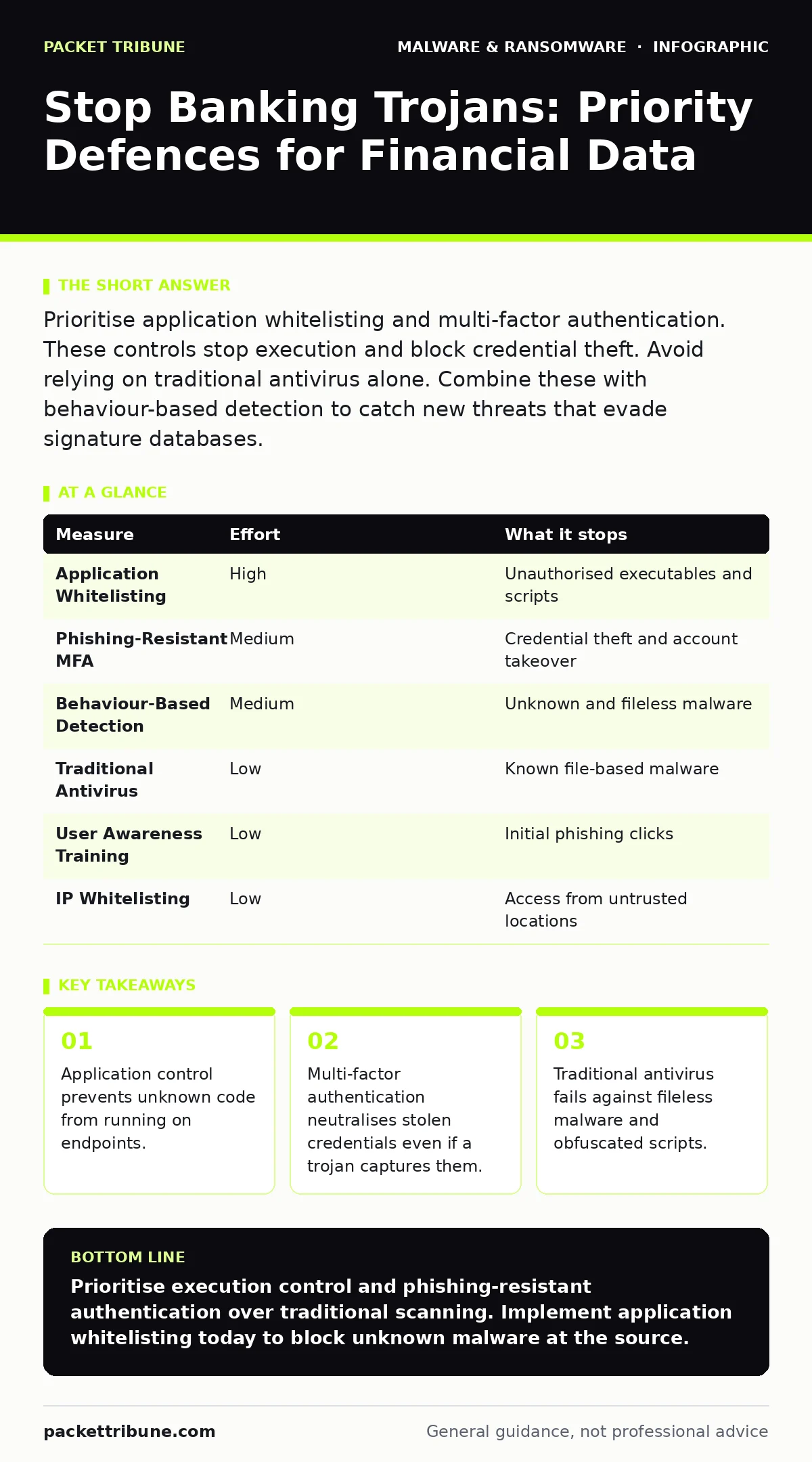
Many organisations rely on outdated measures that provide a false sense of security. Below is a table ranking common measures by their effectiveness against modern banking trojans.
| Measure | Effort | What it stops |
|---|---|---|
| Application Whitelisting | High | Unauthorised executables and scripts |
| Phishing-Resistant MFA | Medium | Credential theft and account takeover |
| Behaviour-Based Detection | Medium | Unknown and fileless malware |
| Traditional Antivirus | Low | Known file-based malware |
| User Awareness Training | Low | Initial phishing clicks |
| IP Whitelisting | Low | Access from untrusted locations |
Quick Wins for Today
You can implement several measures immediately to reduce risk. These steps require minimal effort but provide significant protection.
- Enforce multi-factor authentication for all financial applications.
- Disable Java and other legacy plugins in web browsers.
- Review and restrict administrator privileges on workstations.
These actions address the most common attack vectors. They do not eliminate risk, but they raise the barrier for attackers. Consistent implementation is key to maintaining security.
Closing Checklist
To maintain a strong defence, you must review your controls regularly. Banking trojans evolve quickly, and your strategies must adapt.
- Audit your application whitelist for unnecessary exceptions.
- Test your MFA recovery process to ensure availability.
- Verify that behaviour-based detection is active and tuned.
This checklist ensures your defences remain effective. Regular reviews help identify gaps before attackers exploit them. Stay proactive in your security posture.
Key takeaways
- Application control prevents unknown code from running on endpoints.
- Multi-factor authentication neutralises stolen credentials even if a trojan captures them.
- Traditional antivirus fails against fileless malware and obfuscated scripts.
Prioritise execution control and phishing-resistant authentication over traditional scanning. Implement application whitelisting today to block unknown malware at the source.
Frequently asked questions
Can a banking trojan bypass multi-factor authentication?
Some trojans use real-time man-in-the-browser attacks to intercept MFA codes. However, phishing-resistant methods like FIDO2 keys cannot be intercepted this way.
Is static malware analysis enough for banking security?
No, static analysis cannot detect runtime behaviour or fileless attacks. It must be combined with dynamic analysis and behaviour-based detection.
How do I balance security with user experience?
Use seamless MFA methods and smart whitelisting rules. This minimises friction while maintaining strong security controls.
What is the role of extended detection and response?
XDR correlates data across multiple sources to detect complex threats. It provides visibility that single-point solutions cannot offer.
How this guide was produced: written by the Packet Tribune editorial team with AI assistance, checked against the public references listed below, and reviewed when the facts change. See our editorial policy or report an error.